
 260 Reviews


How to identify a Bee & Wasp Control nest before you do anything about it is the single most useful step in dealing with stinging insects in Texas. The right response depends on the species. Spraying a honey bee colony with consumer wasp spray is illegal in Texas and ecologically harmful. Trying to remove a yellow jacket ground nest without protective gear can put you in the hospital. A paper wasp nest under your eaves is barely worth getting out of bed for; a paper wasp colony inside a wall cavity is a job for a pro.
This guide walks through the five most common Texas stinging insects you’ll find around residential property: paper wasps, mud daubers, yellow jackets, bald-faced hornets, and honey bees. Plus a short note on carpenter bees and cicada killers because Texas homeowners ask about those, too.
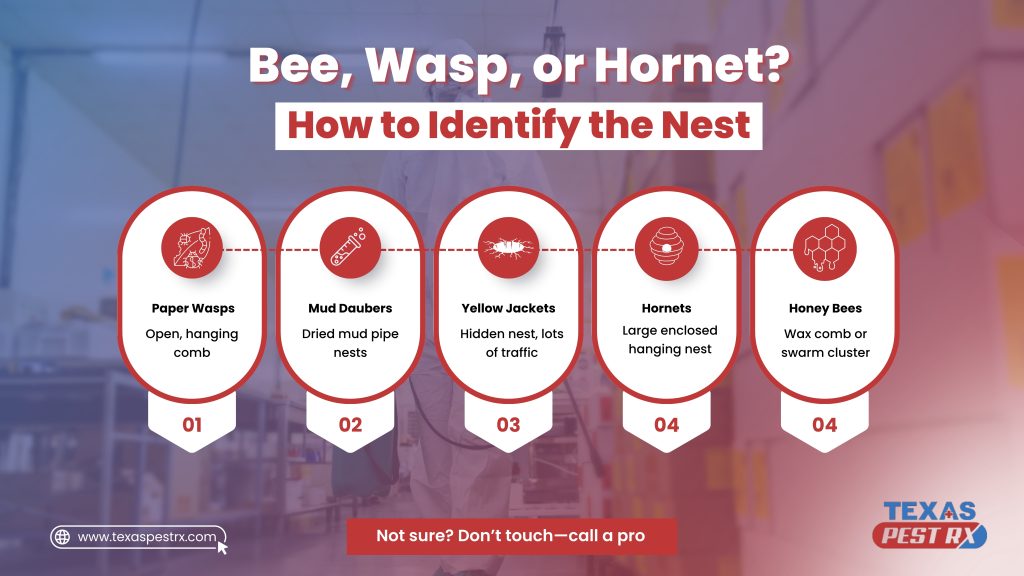
The easiest way to identify is by the nest, not the insect. You can usually see the nest from a safe distance. Trying to look closely at the insect itself is risky and unnecessary.
Paper wasps
The nest: A small open umbrella, gray to tan, with hexagonal cells facing downward. Usually attached to eaves, soffits, deck rails, garden equipment, mailboxes, or anywhere with overhead protection from rain. In an open structure, you can see the larvae in the cells if you look closely.
Size: Most paper wasp nests in Texas hold 20 to 200 wasps at peak in late summer. A nest the size of a coffee mug is typical mid-season.
The wasp: Slender, elongated body, about an inch long, brown or reddish-brown with yellow markings. Long dangling legs in flight. Several Texas species, but the most common around homes is the European paper wasp.
Aggression level: Low to moderate. Paper wasps defend the nest if you get within a few feet, but rarely sting unprovoked. They don’t usually swarm a person.
Risk: Low for most homes. They actually help control caterpillar populations, which is why some pest pros recommend leaving distant nests alone. Treat or remove if the nest is near a doorway, in a kid’s play area, on a deck where you sit, or near a frequently-used path.
DIY or pro? Small, accessible, single nest? DIY-safe with basic precautions (long sleeves, evening application when wasps are dormant, knockdown spray rated for wasps). Multiple nests, a large nest, or hidden inside a structure? Call a pro.
Mud daubers
The nest: A series of tubes made of dried mud, stuck to walls, ceilings, garage corners, sheds, and protected exterior surfaces. Looks like a row of pipes or a clump of mud tubes. Each tube is one cell.
Size: Each mud dauber works alone. There’s no colony where a single female builds her tube nest, lays eggs, and seals the tubes with paralyzed spiders for the larvae to eat. You may see several dauber nests on the same wall, but they’re independent.
The wasp: Slim, often metallic blue-black or black-and-yellow, with a distinct, narrow waist that looks almost like a thread between body sections. About an inch long. Look “weird” that’s the right description.
Aggression level: Very low. Mud daubers are solitary and rarely sting. They might bump you if you get in their flight path, but they don’t defend the nest aggressively.
Risk: Almost zero. Mud daubers eat spiders and pose no real threat to people. The reason to remove the nests is cosmetic (mud tubes on a wall look bad) or because the abandoned nests sometimes get used by more aggressive species later.
DIY or pro? Always DIY-safe. Once the dauber is done with the tubes (usually late summer), you can scrape them off with a putty knife and pressure-wash the wall. No spray needed.
Yellow jackets
The nest: Usually hidden. Most often underground in old rodent burrows, leaf piles, or under decks. Sometimes inside wall cavities, attics, or sheds. The visible sign is constant traffic in and out of a small opening: a hole in the ground, a gap in siding, a void under a step.
If you see a baseball-sized opening with a steady stream of yellow-and-black insects flying in and out, especially in late summer, it’s almost certainly a yellow jacket nest.
Size: Yellow jacket colonies grow large. By August or September, a Texas yellow jacket colony can hold 1,000 to 5,000 individuals.
The insect: Bright yellow and black, shorter and stockier than a paper wasp. Sometimes confused with honey bees, but yellow jackets are smooth (no hair) and brighter yellow.
Aggression level: High, especially late season. Yellow jackets defend the nest aggressively, can sting multiple times, and chase intruders dozens of feet. Multiple stings from a yellow jacket colony cause more emergency room visits in Texas than any other stinging insect.
Risk: High if the nest is near where people walk, kids play, or pets roam. Mowing the lawn over a hidden ground nest is a common scenario for severe stings. A reaction can be life-threatening for allergic individuals.
DIY or pro? Almost always pro. The hidden nature of the nest, the size of the colony, and the aggression level make DIY removal high-risk. If you must DIY, only attempt if you can clearly see the entrance, you can do it at night with proper protective clothing, and you have a wasp killer rated for ground nests with a 15+ foot stream. Otherwise, call.
Bald-faced hornets
The nest: A large gray paper enclosure, football to basketball shaped, hanging from a tree branch, eave, or shed. Closed off (you can’t see inside), with one small entrance hole at the bottom. Smooth gray paper exterior.
Size: Mature nests in Texas hold 200 to 700 hornets. Late-summer nests can be the size of a soccer ball.
The insect: Despite the name, bald-faced “hornets” are actually a type of large wasp. Black with a white face and white markings on the body. Larger than yellow jackets, around 3/4 to 1 inch long.
Aggression level: High. Bald-faced hornets are very defensive of the nest. They can sting through clothing, and they spray a venom that can hit the eyes and cause temporary blindness.
Risk: High. The visible, exposed nature of the nest sometimes makes homeowners think they can handle it. They usually can’t. The nest looks like one organism but holds hundreds of hornets that all leave together when disturbed.
DIY or pro? Pro. The risk-to-reward of DIY is bad. A hornet nest removal is one of the few stinging insect jobs where the pro absolutely earns the fee.
Honey bees
The colony: Wax comb, golden-yellow to brown, hanging in a tree, attic, soffit, or wall cavity. Bees are smaller than wasps, fuzzy (covered in fine hair), and amber-and-brown rather than bright yellow.
A new swarm forms a tight cluster the size of a softball to a basketball, often hanging from a branch. The cluster is bees waiting for scout bees to find a permanent home. After 24-72 hours, the swarm usually moves on.
An established colony has a visible wax comb with thousands of bees crawling on it. You’ll see bees flying in and out of one specific entrance constantly.
Size: Established colonies hold 20,000 to 60,000 bees. A swarm is 5,000 to 20,000.
The bee: Look at the body. Honey bees are fuzzy. Their legs hang down in flight. They’re slower and less aggressive than wasps. Color is amber-brown, not bright yellow-and-black.
Aggression level: Low to moderate. Honey bees only sting when defending the colony or when they feel threatened. A single sting kills the bee. They don’t chase the way yellow jackets do.
Risk: Low for the general public. Higher for allergic individuals or if the colony is in a wall cavity (the comb and honey damage the wall and attract other pests).
DIY or pro? Always pro, and not a typical pest control company. Honey bees in Texas should be removed by a licensed bee removal specialist or beekeeper, not exterminated. Killing honey bees with general-purpose pesticides is harmful and, in some jurisdictions, restricted. Most Texas cities have free or low-cost bee removal services through local beekeepers who relocate the colony.
If a honey bee swarm shows up in your yard, the best action is often to wait. Most swarms move on within 48 hours. If they settle into a wall cavity or an attic, then call a beekeeper.
Carpenter bees and cicada killers
Carpenter bees: Look like big, fat bumblebees, but the abdomen is shiny black instead of fuzzy yellow. They drill perfectly round 1/2-inch holes into wood (eaves, decks, fence posts) to lay eggs. Solitary, not aggressive (males look fierce but can’t sting; females rarely sting). Treatment is sealing or treating the holes plus deterring future drilling. DIY-safe.
Cicada killers: The largest wasp in Texas, 1.5 to 2 inches long, intimidating to see. Dig holes in dry sandy ground to bury paralyzed cicadas as food for larvae. Solitary, rarely sting humans (males can’t sting, females rarely do). Treatment usually unnecessary unless they’re tearing up a lawn. If needed, treat the burrows individually. DIY-safe with caution.
Decision tree: should you DIY or call a pro?
| Insect | Nest accessible? | Colony size | DIY OK? |
| Paper wasp | Yes, eaves/visible | Small (under 100) | Yes, with care |
| Paper wasp | Hidden in the wall | Any | Pro |
| Mud dauber | Any | Single per tube | Yes, after they leave |
| Yellow jacket | Visible ground entrance, far from the house | Any | Maybe (high risk) |
| Yellow jacket | In the wall, attic, and deck | Any | Pro |
| Bald-faced hornet | Any | Any | Pro |
| Honey bees | Any | Any | Beekeeper, not exterminator |
| Carpenter bees | Visible holes | Solitary | Yes |
| Cicada killers | Lawn burrows | Solitary | Yes (often unnecessary) |
The general rule: aggressive species inside structures or in places people walk equals pro. Solitary species outdoors equals DIY. Honey bees always equal a beekeeper.
When to act vs. when to leave alone
A common mistake is treating every stinging insect as an emergency. They’re not. Some general guidelines for when leaving the nest alone is fine.
- Paper wasp nest more than 10 feet from any walking path or doorway: Often fine to leave. They die off in late fall and don’t reuse the nest next year.
- Mud daubers anywhere: Almost always fine to leave. They’re not aggressive.
- Carpenter bees on a fence post you don’t care about: Decide based on whether you’re losing structural wood.
- A swarm of honey bees that just landed in your tree: Wait 48 hours. Most move on.
- Cicada killers in a sandy area away from kids and pets: Leave them, they’re done by fall.
When to act fast:
- Yellow jacket ground nest near walking path or kids’ play area: Treat or remove this week.
- Hornet nest within 20 feet of where people sit: Treat or remove this week.
- Honey bee colony established inside a wall cavity: Schedule the beekeeper this month before the comb damage worsens.
- Any stinging insect nest near a sleep area (bedroom window): Treat this week.
What We Actually Do for Each Species
When homeowners call us for a stinging insect inspection in Texas, the process is straightforward and species-specific. At Texas Pest RX, we start by inspecting the entire property to locate every active nest, then document what we find with photos. From there, we identify the exact species because treatment depends heavily on whether you’re dealing with bees, paper wasps, yellow jackets, or hornets.
Once identification is complete, we recommend the safest and most appropriate next step for each nest—whether that means treatment, physical removal, beekeeper relocation, or simply leaving it alone if it poses little risk. Any work that requires action is provided with a clear written quote before we begin.
For paper wasps, we typically use targeted evening treatments when activity is lowest. Yellow jackets and hornets require full protective equipment and species-specific control methods due to their aggressive behavior. Honey bees are handled differently. We always recommend live relocation through a local beekeeper and do not exterminate bee colonies.
If you’ve found a nest but aren’t sure what you’re looking at, send us a photo (/contact-us/). We’ll help identify the insect and let you know whether it’s something that needs immediate attention or something that can safely be left alone.


