
 260 Reviews


In Wilson County, a one-time general pest treatment usually runs about $150 to $350, and an initial visit that includes a full inspection often lands around $175 to $400. Ongoing quarterly service, the option most homes here end up on, typically costs about $100 to $200 per visit, or roughly $400 to $720 a year. Monthly plans sit lower per visit (around $40 to $75) but bill more often. Termite work is separate and priced by structure. Treat every figure here as a range: your quote moves with home size, acreage, pest, and how bad things already are.
What This Cost Guide Actually Covers
Most pricing pages give you a single national average and call it a day. That number is close to useless in Floresville or La Vernia, where lots run bigger, homes back up to pasture and brush, and pests never really shut off for winter. Below we walk through real local price ranges for one-time and quarterly service, the four things that actually move a quote up or down out here, the honest math on when a contract beats a single visit, and the one cost driver rural Wilson County homes hit that suburban San Antonio homes usually skip. We would rather you know the ranges before we ever pull into the driveway.
Wilson County Pest Control Prices, Labeled As Ranges
Here is what pest control costs look like locally in 2026, based on current Texas and South Texas market rates. These are ranges, not flat prices, because no honest company can quote a real number without seeing your property first.
| Service type | Typical local range | What it usually includes |
| One-time general treatment | $150 to $350 | Single interior and exterior treatment for common pests |
| Initial visit (first service on a plan) | $175 to $400 | Full inspection, heavier first knockdown, entry-point work |
| Quarterly service (per visit) | $100 to $200 | Recurring exterior and targeted interior, free re-treats between visits |
| Monthly service (per visit) | $40 to $75 | Lighter, more frequent exterior maintenance |
| Annual cost on a recurring plan | $400 to $720 | Full year of quarterly or monthly coverage |
| Fire ant program (add-on) | $50 to $150 per treatment | Targeted baiting on top of general service |
| Termite treatment (separate service) | $800 to $3,500+ | Priced by linear feet and method, liquid or bait |
A few honest notes on that table. The quarterly range is where most Wilson County households actually land, because our pest pressure runs year-round and a single treatment rarely holds past a season. Termite work is its own animal and does not belong inside a general pest quote, so we price it after an inspection, never sight unseen. And fire ants often ride along as an add-on rather than being baked into the base rate.
One-Time Vs Quarterly: The Honest Math
The real question behind most calls is not the sticker price; it is whether to pay once or sign up for ongoing service. Here is the straight version.
A one-time treatment makes sense when you have a single, contained problem: a wave of crickets after a rain, ants marching across one counter, a wasp nest by the front door. You pay the $150 to $350 range once, we knock it down, and you are done. What a one-time visit does not do is stop the next wave, and around here there is almost always a next wave.
Quarterly service costs more over a year, but less per problem. At roughly $100 to $200 a visit, four visits run about $400 to $720 annually, and reputable plans include free re-treatments if pests come back between scheduled stops. Do the math on a bad year: three separate one-time calls for ants in spring, scorpions in summer, and crickets in fall can quietly cost as much as a full quarterly plan while leaving you unprotected in the gaps.
Our honest take, after years of running routes across the county: if your home borders pasture, brush, a creek, or an older detached structure, quarterly almost always wins on both cost and sanity. If you are in a tighter subdivision lot with a one-off issue, a single visit may be all you need. We will tell you which camp you are in instead of pushing everyone toward a contract.
What Actually Moves Your Wilson County Pest Control Quote
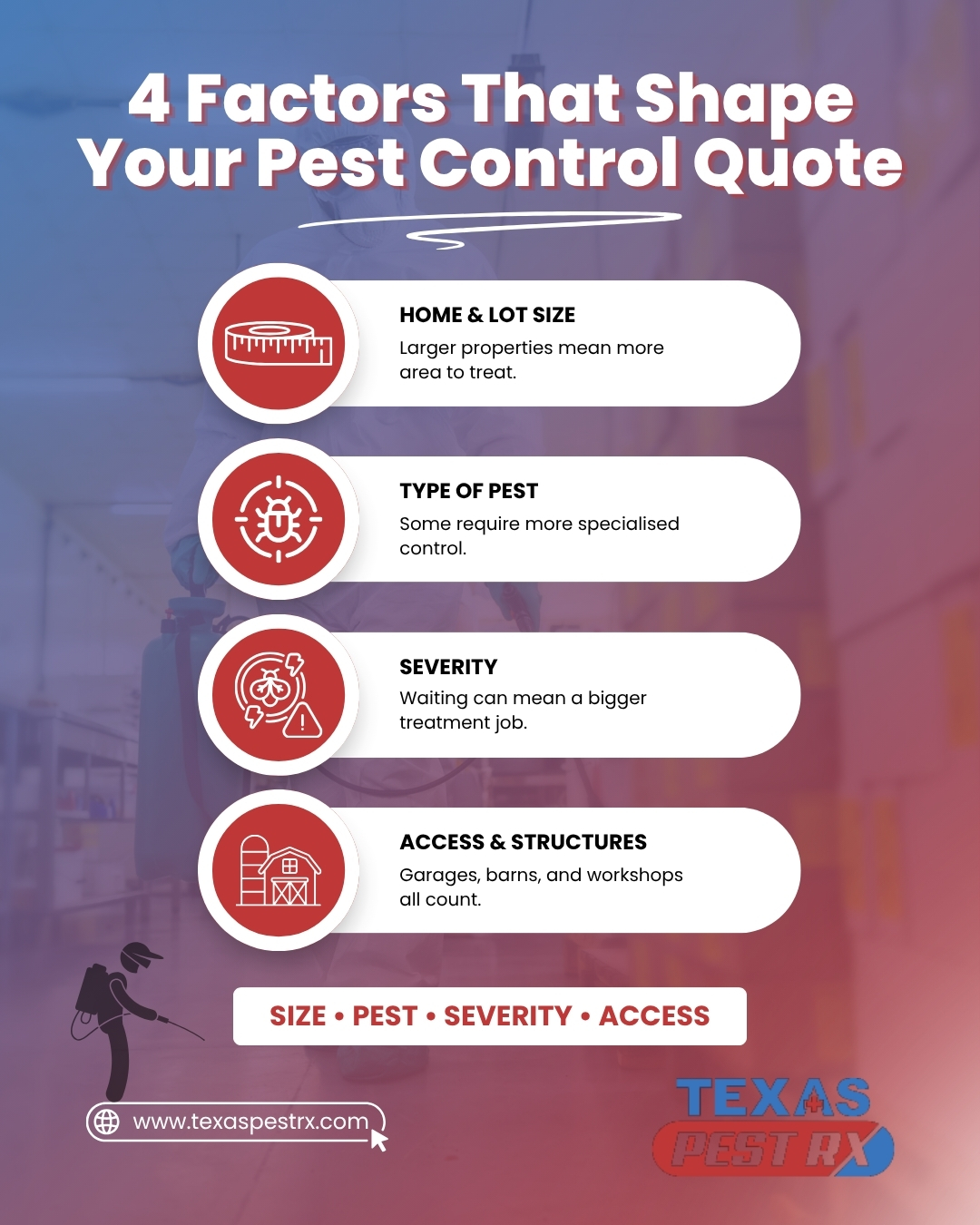
Four factors do most of the work in any Wilson County pest control estimate. Knowing them lets you read a quote instead of just reacting to it.
- Home and lot size: Square footage sets the base, but out here the lot matters as much as the house. A 2,000 square foot home on a half acre and the same home on five acres of brush are not the same job, because the perimeter and harborage we treat are completely different.
- The specific pest: General ants and roaches sit at the low end. Fire ants, scorpion control, and termites need targeted products and more time, which is why they land as add-ons or separate services.
- How bad it already is: An early call for a few sightings is cheaper than a full-blown infestation that has moved into walls, an attic, or a slab. Waiting almost always costs more, not less.
- Access and structures: Detached garages, barns, well houses, deer blinds, and workshops all add treatable area. Rural properties routinely have three or four structures where a suburban lot has one.
That last point is the one we flag most, and it is the local detail generic Texas pricing guides skip entirely.
The rural acreage factor most guides ignore
Here is the practitioner insight you will not find on a national cost page. On a lot of Wilson County properties, the house is only part of the job. We regularly quote homes across our pest control service areas in La Vernia, Stockdale, and out toward Sutherland Springs where the barn, the well house, the shop, and the treeline all need attention, because that is where scorpions harbor and where rodent control matters as they stage before moving into the house when it gets hot or cold.
A pest control cost quote built only on the home’s square footage will look cheap and then fail, because the pests are living in the outbuildings, not the living room. When we walk a rural property, we count structures and pace the perimeter, not just the interior. That is why two homes with identical square footage can get quotes a hundred dollars apart, and why a lowball phone estimate that never asked about your acreage is a red flag, not a bargain.
Why Pricing Runs The Way It Does Here
Wilson County sits in that band of South Central Texas where pests barely take a winter off. Mild winters mean fire ants, scorpions, spiders, and rodents stay active far longer than they would up north, so the “treat once and forget it” model that works in colder states does not hold here. That year-round pressure is the single biggest reason recurring plans tend to price out better per problem than repeated one-time calls.
Soil and setting matter too. Much of the county runs to heavy clay that shifts and cracks in our dry stretches, opening gaps around slabs and foundations that pests use as highways indoors. Homes backing onto pasture, cropland, or creek bottoms get steady pressure from whatever is living in that cover. None of this is priced to punish rural homeowners; it simply reflects that a five-acre property with three structures next to a treeline is more work than a zero-lot-line home in town.
When Pest Pressure Peaks And What It Does To Cost
Timing changes what you pay, because the pest driving your call changes through the year. Understanding the local calendar helps you decide whether to hold out for a plan or handle a one-off now.
Spring, roughly March into May, brings the first ant and termite swarms. Warm soil wakes fire ant mounds across yards and pastures, and that is when a lot of one-time ant calls come in. Summer is scorpion and spider season, the stretch when limestone and clay heat up and drive them toward cooler interiors, and it is also peak mosquito time near any standing water or creek bottom. Early fall, September and October, is cricket season, when swarms hit porches and garages after the first cool snaps. Late fall into winter is rodent season, as mice and rats look for warmth and push in from outbuildings and treelines.
Here is why that matters for pest control cost. A household that calls three separate times, once for spring ants, once for summer scorpions, once for fall crickets, can spend as much on one-time visits as a full year of quarterly service would have cost, and still have gaps in coverage the rest of the year. The seasonal spread is exactly the argument for recurring service in a climate like ours, where something is active in almost every month.
How To Compare Quotes Without Getting Burned
Cheapest is not the same as best value, and the gap usually shows up two months later. When you collect estimates, line them up on the same terms:
- Ask what the base rate actually covers, and which pests are add-ons.
- Confirm whether re-treatments between visits are free or billed.
- Make sure the quote was based on an actual look at your property, structures, and acreage included, not just your address.
- Check that the company is licensed in Texas and will name the products and the pests they are targeting.
A quote that is far below everyone else’s is often missing coverage, missing your outbuildings, or missing free re-treats. Get it in writing so you are comparing the same job, not the same slogan.
What A Fair Local Quote Process Looks Like
A good estimate should feel like a diagnosis, not a sales script. When we quote a Wilson County home, we start by asking what you are actually seeing and where, then we walk the exterior perimeter, check entry points around the slab, and count the structures that need treating. Only then does a number make sense. If a company gives you a firm price over the phone without any of that, they are guessing, and you usually pay for the guess later.
Ask up front what happens if pests come back between visits. On a quarterly plan, re-treatments should be included at no extra charge, and a company confident in its work will say so without hesitation. Ask which products go where, especially if you have kids, pets, a well, or livestock, because responsible application around a rural property looks different than it does on a quarter-acre lot in town. And ask whether the price locks in or climbs after the first visit, so the quarterly cost you agree to is the quarterly cost you keep paying.
The homes that end up happiest with what they spend are usually the ones that called early, got an honest walkthrough, and matched the plan to the property instead of to a coupon. Spending a little on prevention beats spending a lot on an infestation that got a full season’s head start.
Where to go from here
The short version: budget for the ranges above, expect a real quote to reflect your home, your acreage, and your specific pest, and be wary of any number given before someone actually looks. For a straight, no-pressure estimate built on your actual property rather than a national average, reach out to Texas Pest RX, and we will walk it with you. Whether you need a single knockdown or want to book quarterly coverage, we would rather set honest expectations up front than surprise you on the invoice.


