
 260 Reviews


TL;DR
Late summer wasp aggression around San Antonio comes from two things happening at once. Colonies hit their maximum worker count after months of growth, and the queen stops laying, so the nest no longer needs the protein its foragers spent all spring collecting. Texas A&M AgriLife documents the late-summer shutdown of egg-laying in paper wasps, and the University of California IPM documents the corresponding shift toward sugar foraging.
The practical result across Floresville, Seguin, Cibolo, and New Braunfels is more wasps at close range on patios, feeders, trash bins, and fallen fruit, and shorter tempers around any nest. Nothing about their venom changes. The odds of standing next to one when it feels crowded go way up.
What Changes Inside a Wasp Nest in August
Through spring and early summer, the nest runs on protein. Workers hunt caterpillars and other insects, chew them up, and feed the resulting mass to the larvae. University of California IPM describes the same growth phase for social wasps in its social wasp pest note: from spring to midsummer, the larvae require large amounts of protein, and the workers forage mainly for it.
Then the nursery closes.
Texas A&M AgriLife’s Texas Insects field guide states that in late summer, paper wasp queens stop laying eggs and the colony soon begins to decline. Fewer larvae means less of the work the adults were built around. It also means less of the sugary fluid the larvae hand back to the adults that feed them, which had been the workers’ own steady meal all season.
So the foraging job flips. University of California IPM puts it plainly: by late summer the colonies grow more slowly or stop growing, need large amounts of sugar to keep the queen and workers going, and foraging wasps are particularly interested in sweet things at that point. Sweet things, in Wilson County in September, mean a can of Big Red on a tailgate, the hummingbird feeder by the porch, dropped figs, split pecans, a trash bag with soda in it, and the wet ring under a kid’s cup.
That is the whole mechanism.
The wasps did not get meaner. They got hungrier for exactly the things humans leave sitting outdoors, and there are more of them than at any other point in the year to want it.
Population is the second half. A mature paper wasp nest may hold 20 to 30 adults, and mature nests contain up to 200 cells, according to the same AgriLife guide.
Yellowjackets run far higher. The same UC IPM pest note reports social wasp colonies reaching populations between 1,500 and 15,000 individuals depending on species, and AgriLife reports that southern yellowjacket colonies can contain up to 4,000 workers. A colony at that size in April was a handful of wasps you never noticed.
Are Wasps Really More Aggressive, or Just Everywhere at Once?
Mostly the second one, with a real exception. Wasps foraging away from the nest are not looking for a fight. Texas A&M AgriLife’s Insects in the City program notes that wasps and hornets are typically not aggressive when they are out foraging around flowers or a trash can. What changes near the nest is defense, and a bigger nest defends harder.
The exception matters because it is where people get hurt. Yellowjackets are very protective of their colony and may attack when the nest is threatened, and AgriLife specifically names vibrations from mowing as a trigger. A nest that was a quiet hole in the pasture in June is a 4,000-worker colony in September, sitting under a lawn mower deck.
Here is the honest read from doing this work in South Texas. The wasp that lands on your plate at a backyard cookout in Seguin or south San Antonio is a nuisance and will usually leave. The wasp you cannot see, twelve inches under the St. Augustine you are about to run a mower over, is the one that puts people in an urgent care waiting room. Those are two different problems, and they get handled differently.
The Texas Detail That Northern Wasp Advice Gets Wrong
Almost every article on this subject was written for a climate that freezes hard.
Those pieces all end the same way: wait for frost, the colony dies, the nest is empty by November, do not bother treating it.
That advice does not transfer here. UC IPM notes that yellowjacket and paper wasp colonies normally live only one season, and then flags the exception for mild winters. AgriLife applies the same exception to us directly: in Texas, some southern yellowjacket colonies can survive for several years and continue to grow. The same page reports colonies in Texas and other southern states measured at 6 feet across.
Sit with that number.
Six feet across is not a nest you wait out. It is a multi-season colony in a wall void, a crawlspace, an old rodent burrow along a fence line, or the hollow under a slab porch, and it started as something a homeowner decided to ignore in September because the internet said frost would handle it.
We see the consequence most on older Wilson County properties and on acreage out toward Pleasanton and Poth, where a nest can sit in a barn wall or a brush pile for two or three years without anyone standing close enough to notice. By the time it announces itself, the treatment is a different job entirely.
The other Texas wrinkle is calendar length. Our warm afternoons run deep into fall, so the weeks when workers are out scavenging sugar last considerably longer here than the northern posts assume. Late August through October is the live window, not a two-week blip.
Where the Late Season Nests Sit Around Here
Paper wasps go aerial and obvious: eaves, porch ceilings, patio umbrellas left folded, the underside of a grill lid, gas meter housings, and the inside lip of a mailbox. AgriLife notes their nests commonly occur around the home underneath eaves and in or on structures and plants.
Yellowjackets go hidden, and that is the whole problem.
The same guide records nests as most often underground, occasionally in wall voids and indoors. Around here that means abandoned rodent burrows along pasture fence lines, the gap under a concrete step, irrigation valve boxes, water meter boxes at the curb, and the soffit returns on newer construction in Cibolo and Schertz where the framing crew left a finger-width gap at the corner. None of those announce themselves from the porch. You find them by watching for a steady line of insects flying in and out of one fixed point, which is a very different search from spotting a grey paper nest under an eave, and it is the reason a September walk of the property beats any amount of squinting at the roofline.
If you want to work out which one you have before you get anywhere near it, we wrote a separate walkthrough on telling one stinging insect nest from another at a distance.
How Each Species Behaves Differently After Mid-August
Not every stinging insect in the yard changes the same way, and the response is different for each. This is the part generic seasonal articles skip.
| Insect | What changes in late summer | Usual trigger | Late-season risk |
| Paper wasp | Queen stops laying, colony declines, adults linger on the nest | Bumping the eave, ladder work, pressure washing | Moderate, and each female can sting repeatedly |
| Southern yellowjacket | Colony at maximum workers, heavy sugar scavenging | Mower vibration, foot traffic over a ground nest | High, mass stinging events start here |
| Mud dauber | Little change, solitary, still working mud tubes | Handling one directly | Low, AgriLife calls them very docile |
| Cicada killer | Males patrol and buzz people, females burrow | Walking through their patch of bare ground | Low, the dramatic ones cannot sting |
| Honey bee | Colony defensive of stores as forage drops off | Anything near a hive entrance | Handled by relocation, not treatment |
The cicada killer line is worth pausing on because it generates the most panic calls we get in August. Those solitary wasps reach two inches long and burrow into the ground to nest, per AgriLife, and only the females sting. The two-inch insect buzzing your head in a bare patch of yard is almost always a male doing a territorial display with no stinger at all.
Why Swatting One Wasp Brings the Rest
Because a wasp under attack calls for help chemically. Virginia Tech Extension’s yellowjacket publication, ENTO-49, states that yellowjackets release an alarm pheromone when attacked, which stirs other nestmates into attacking the intruder as a group.
Swatting one on the patio is usually harmless. Crushing one within range of the nest is how a single sting turns into eleven.
The rule we give people is short: kill nothing near a nest, walk away instead, and deal with the nest later at the right time of day.
What Actually Works in a South Texas Yard Right Now
Take the sugar away first.
Sugar is the entire reason they are at your elbow, and every step below is aimed at removing it from the places people stand.
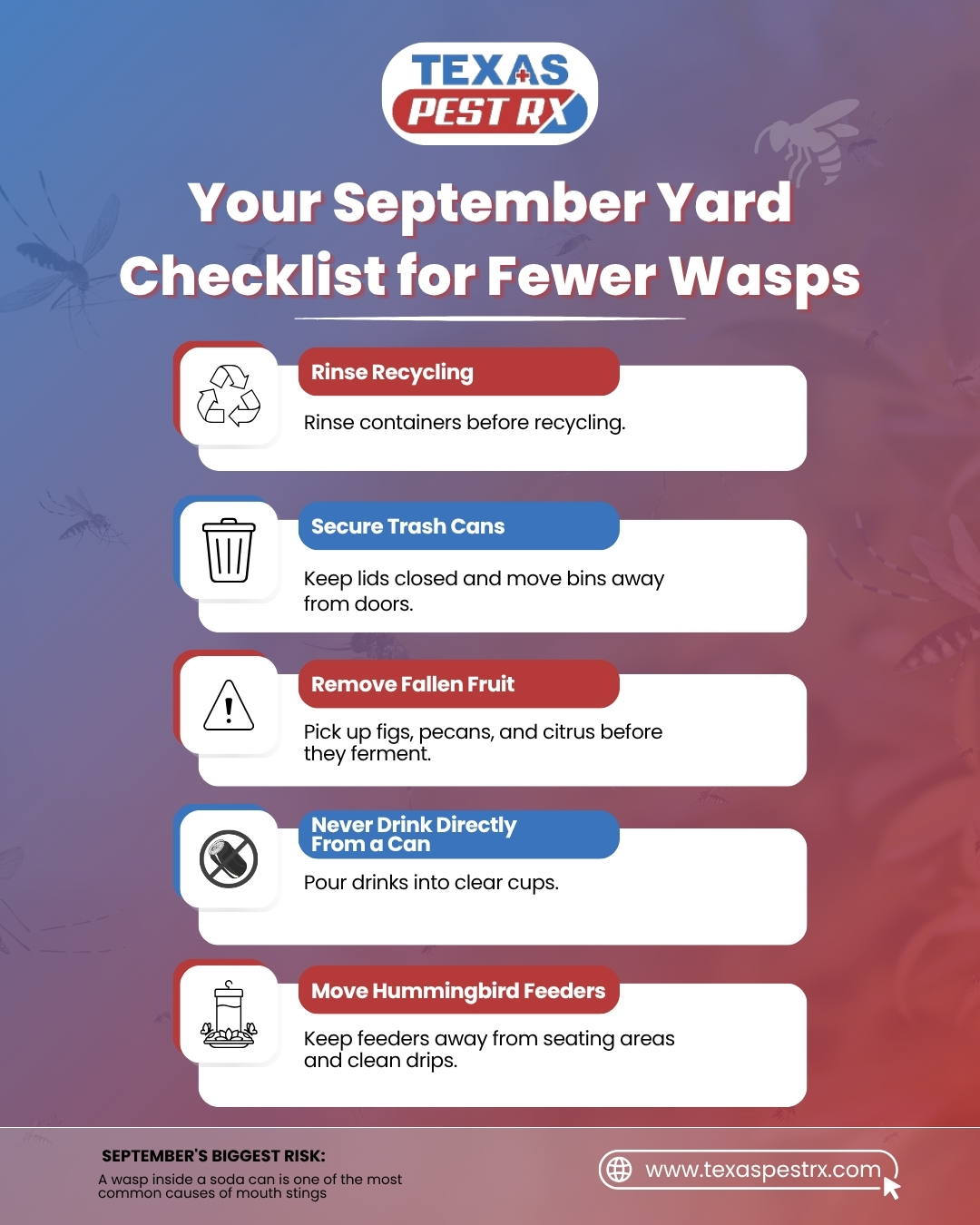
- Rinse recycling before it goes in the bin.
- Keep trash cans latched, and move them away from the door people actually use.
- Pick up dropped figs, pecans, and citrus under the tree rather than raking them into a pile that ferments.
- Pour from cans into cups you can see into. A wasp inside an aluminum can is the most common way people get stung in the mouth in September.
- Move the hummingbird feeder well away from where anyone sits, and wipe the drip.
Then handle the ground.
Walk the yard before you mow, in the morning, looking for steady insect traffic in and out of one spot in the grass or along a fence line. It takes two minutes, and it prevents the worst outcome described anywhere on this page. Flag the spot and mow around it until the nest is dealt with. On acreage, check the fence line and the base of any brush pile as well, since that is where the burrows are.
Store-bought lure traps deserve a caveat almost nobody gives you. UC IPM reports that lure traps can help reduce the number of localized foraging workers but do not eliminate large populations, and that the common lure chemical in them, heptyl butyrate, attracts primarily the western yellowjacket rather than other species. Our problem species here is the southern yellowjacket. A trap hung on a Floresville patio may thin the wasps hovering over the table and will do nothing at all about the colony under the fence line.
Ground nests and interior wall voids are where we stop recommending anything from a hardware store. That is the point where our stinging insect control work becomes locating the real entrance, treating at dusk or first light when the whole colony is home, and using a dust that workers carry inward rather than a stream that only kills what is standing at the door. If you want the step-by-step version of that visit, we described how a removal actually runs in an earlier post.
Do Store-Bought Wasp Sprays Work in September?
On an exposed paper wasp nest under an eave, sprayed after dark or before sunrise when the adults are on the nest, a labeled aerosol can do the job. Extension guidance from AgriLife on paper wasps is to spray from a safe distance early in the morning or just before dark. On a mature ground colony or anything inside a wall, that same can mostly produces angry wasps and a stained wall.
There is a legal layer people do not think about. Pesticide labels are not marketing copy. The EPA’s guidance on pesticide labels states that they are legally enforceable and that every one of them carries the line “It is a violation of Federal law to use this product in a manner inconsistent with its labeling.” Pouring gasoline down a yellowjacket hole, mixing products, or using an outdoor concentrate inside a wall void is not a shortcut. It is an illegal application and a fire hazard, and we get called to clean up after it every fall.
For the same reason, anyone treating your structure for pay has to be licensed. The Texas Department of Agriculture administers the Structural Pest Control Act, Chapter 1951 of the Occupations Code, which requires licensing of businesses and individuals that perform structural pest control for hire. Ask for the license number before anyone sprays anything on your property. Any honest company hands it over without blinking.
When a Sting Needs More Than Ice
Most stings hurt, swell, and settle down. The AgriLife field guide is direct about the exception: paper wasp stings typically cause localized pain and swelling, but in sensitive individuals, or when many stings occur, whole-body effects can happen, including allergic reactions that may result in death.
Two situations change the math. The first is volume, because a disturbed ground colony can deliver dozens of stings in seconds, and wasps do not lose the stinger, so each female can sting repeatedly. The second is sensitivity, which people often do not know they have until the day they find out.
Trouble breathing, swelling away from the sting site, dizziness, or a spreading rash after a sting is an emergency room trip, not a wait-and-see. Get seen.
Clearing Late Summer Wasps Before September Peaks
The cheapest week to handle a wasp nest around here is the week before somebody gets stung by it. Right now, across San Antonio, Seguin, Cibolo, and out through Wilson County, the colonies that have been quietly building since April are at their largest, and their foragers are working every sweet thing in the yard.
Walk your eaves, your porch ceilings, your meter boxes, and your fence lines this week, in the morning, from a distance. Flag anything with steady traffic and stop mowing over it. A small aerial nest you can reach may need nothing more than a labeled aerosol at dusk.
If it is in the ground, in a wall, or bigger than your fist, call us at 830-393-6964 and let Texas Pest RX put someone in a bee suit on it instead. We run the whole service area from Floresville out through the San Antonio suburbs, including New Braunfels and Pleasanton.


