
 260 Reviews


Quick answer
The five biggest pest control red flags in Texas: high-pressure sales after a “free” inspection, treatment quotes with no specific pest or method named, contracts that auto-renew without notice, technicians who can’t show a Texas Structural Pest Control license number, and chemical applications without a written list of what’s being sprayed. Any one of these means stop, get a second opinion, and don’t sign that day. The Texas pest control industry has solid operators and a lot of pressure-sales operations. Knowing the difference saves money and keeps your home safer.
Pest control red flags show up more often here than in many states for three reasons. First, our climate makes pest pressure year-round, with fire ants in spring, scorpions and roaches in summer, rodents in fall, and termites swarming in spring, so homeowners are always somewhat aware they could have a problem. Second, the state has loose enforcement of door-to-door home services compared to states like California or New York, which means high-pressure operators travel through neighborhoods finding willing audiences. Third, Texas homeowners tend to trust uniform-and-truck operations more than they should.
The Texas Department of Agriculture’s Structural Pest Control Service in Texas licenses every legitimate. That license is the bedrock of legitimacy. Above that, individual technicians need certifications. Below that, anyone with a sprayer can charge you money for what looks like the same service.
This guide covers the five most common red flags we see homeowners describe when they call us for a second opinion. Some have already paid the bad operator and want to know if they can get out of the contract. Most are calling before they sign. The earlier you spot the pattern, the better.
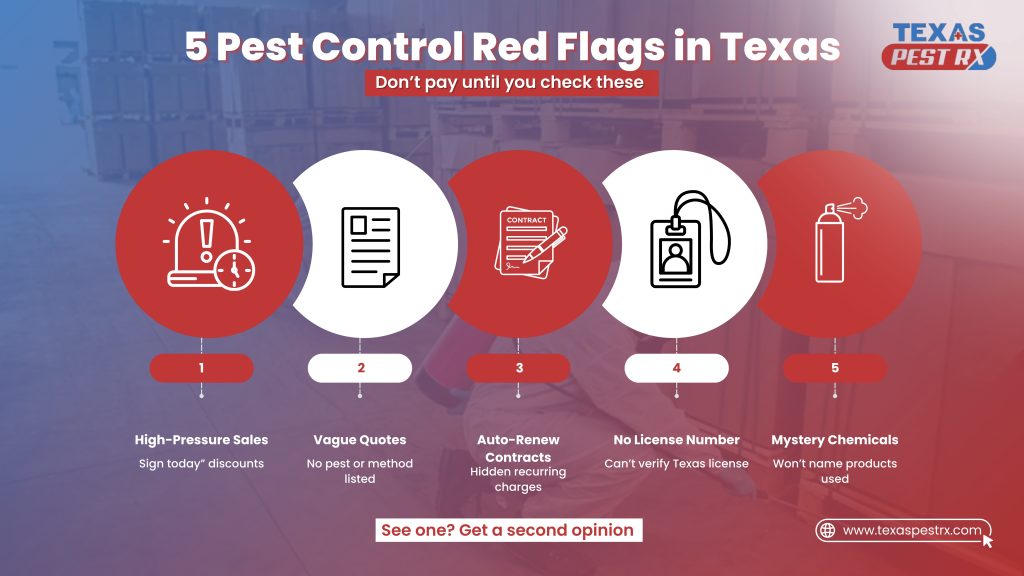
Red flag 1: High-pressure same-day signing
The pattern goes like this. A free inspection technician comes to your home. They walk around for 15-30 minutes. They come back with a serious face and tell you what they found. Termites, rodents in the attic, brown recluse evidence, mold tubes in the foundation, the specific scary thing varies. They tell you the problem is bad, that it’s spreading, and that they have a treatment crew available “this afternoon” or “tomorrow morning” if you sign now.
The offer comes with a today-only discount. The original price is $2,800; today it’s $1,400. They imply the price doubles tomorrow. They might offer a payment plan to make the decision today easier.
This is the oldest play in home services. Real pest infestations don’t require the same-day decisions. Termites don’t move that fast. Rodents don’t multiply faster overnight than they did this morning. The urgency is manufactured.
What to do: thank them for the inspection report, take a copy of whatever evidence they say they found, and tell them you’ll review it and call them back. Then call two other licensed Texas pest control companies for second opinions on the specific finding. Show them the photos or the evidence that the first tech provided. If the first tech invented the problem, the second opinions will say so.
If a company refuses to leave a written copy of the inspection findings, that’s already enough of a red flag to walk away.
Red flag 2: Vague treatment quotes
A real pest control quote names the pest, the treatment method, the specific products being applied, and the warranty terms. A vague quote names the price and not much else.
Bad quote example: $2,200 for whole-house pest treatment with three follow-ups.
Good quote example: $1,850 for liquid termite treatment around foundation perimeter using Termidor SC, applied at 0.06% concentration, with re-treatment guarantee for 12 months and annual inspection at no additional cost.
The good quote tells you exactly what’s being done, with what product, at what concentration, and what happens if it doesn’t work. The bad quote leaves the actual scope of work vague enough that the technician can decide later whether to do the basic version or the premium version that costs you the full $2,200.
Vague quotes also create disputes when problems persist. If the contract just said “pest treatment,” the company can argue they did pest treatment and walk away when the pests come back. A specific contract names what the warranty covers and what triggers retreatment.
What to ask before signing: What pest are we treating? What product, by name? What concentration or dose rate? Where is the application happening (foundation, attic, kitchen, perimeter)? What’s the warranty? What triggers re-treatment under the warranty?
If the salesperson can’t answer any of those questions in plain language, the technician sent later won’t know either.
Red flag 3: Auto-renewing contracts
This is the legal trap that catches the most homeowners. The contract you sign for a one-time “termite treatment with annual inspection” auto-renews into an ongoing pest control plan. Year two, you owe $480. Year three, $510. You never agreed to recurring service, but the contract you signed says you did.
If they refuse to remove or modify auto-renewal language, that’s a red flag. Reputable companies offer ongoing service as an opt-in next year, not a default that requires you to opt out.
For existing contracts: send a written cancellation by certified mail at the first opportunity. Keep the receipt. Document everything. The Better Business Bureau and the Wilson County Attorney General’s consumer protection division both take complaints on auto-renewal abuse.
Red flag 4: No license number
Every legitimate pest control company in Texas has a Structural Pest Control license issued by the Texas Department of Agriculture (TDA). Every technician applying chemicals must hold a Certified Applicator or Technician license. Both types of licenses have specific numbers that are public record.
A legitimate company has the license number on:
- Their truck (state law requires it)
- Their invoices and contracts
- Their website
- The clothing or ID badge of the technician
If you can’t find a license number on any of these, the company is either operating illegally or hiding something.
How to verify: go to the TDA’s pest control license search tool online. Type in the company name or the license number. The result tells you if the license is current, what license type they hold, what they’re authorized to treat, and whether complaints have been filed against them.
If the search returns license expired, or no record found, or complaint pending, stop and find another company. Treatments performed by an unlicensed person on your property may also void the warranty on any pest-related home insurance claim, and they can’t legally apply restricted-use pesticides.
Red flag 5: Mystery chemicals
Texas law requires pest control operators to provide a written list of pesticides applied to your property if you ask for one. The label, the EPA registration number, the active ingredient, and the safety data sheet (SDS) should be available.
A scam operator answers what are you spraying? With vague replies: It’s a professional-grade product, it’s registered with the EPA, that’s all you need to know. It’s a proprietary blend. None of that is acceptable. You have a legal right to know what’s being put on or in your home.
Why this matters in Texas:
- Pets and small children are commonly exposed to residual chemicals, especially when sprays are applied to interior baseboards, kitchen perimeters, or yard areas.
- Different pesticides have different reentry intervals, the safe time before pets and people can be in treated areas.
- Some of the cheapest unbranded products used by scam operators contain pesticides not approved for indoor use, or are diluted improperly.
What to ask before any application: What product, by name, are you applying to? What’s the active ingredient? What’s the EPA registration number? When can my pets and kids return to the treated area? Is there an SDS I can have?”
The right answer takes 60 seconds for a real technician to provide. The wrong answer is hesitation, deflection, or a vague reassurance.
If the company has already applied something and won’t tell you what, you can call the TDA consumer hotline. They have the authority to require disclosure.
What a legitimate company sounds like
To balance the warning signs, here’s what a real Texas pest control company looks like during the same kind of inspection.
The technician shows up in a marked truck with the company name and license number visible on both sides. They wear a uniform with an ID badge. They introduce themselves with their first name and certification level.
The inspection takes 30 to 60 minutes for a typical Texas single-family home. The tech asks you what you’re seeing, where, and when. They check the actual areas you describe. They check standard problem zones: foundation perimeter, attic access, garage, kitchen baseboards, and water sources.
After the inspection, they sit at your kitchen table, draw a simple diagram of the home, mark where they found evidence, and tell you what kind of pest activity is consistent with that evidence. They name the pest. They describe the treatment options at different price points. They give you a written quote with everything spelled out: pest, product, concentration, application zones, warranty terms, total cost, and what’s NOT included.
They tell you to take a few days. They suggest you get a second opinion if you want. They leave their business card with the license number on it.
How to verify before paying
Five-step verification process before signing any pest control contract in Texas.
- Check the TDA license online: Active, valid, no pending complaints. Takes 30 seconds.
- Search the company’s BBB rating: A B or better is fine. C or below, look closer at the complaints. Pattern of unresolved complaints is a red flag.
- Search Google for the company name + scam or lawsuit.: Read what comes up. Texas attorney general consumer alerts often surface here.
- Call two other licensed companies for second opinions: Compare the diagnosis. If three companies all say the same thing, you have a real problem. If only the first one saw it, you have a scam.
- Read the contract before signing: Specifically look for auto-renewal language, vague scope, missing license numbers, and missing chemical disclosure.
This entire process takes about 90 minutes. The cost of a wrong decision in pest control runs from $500 to several thousand dollars and leaves you exposed to whatever real problem you might or might not have. Ninety minutes is cheap insurance.
What to do if you’ve already paid a scam company
If you signed under high pressure, paid for a treatment that didn’t address a real problem, or got locked into an auto-renewal you didn’t agree to:
- Stop additional payments immediately. If on autopay, cancel the autopay through your bank.
- Document everything: contract, invoices, communications, and photos of any treatment areas.
- File a complaint with the Texas Department of Agriculture Structural Pest Control Service.
- File a complaint with the Texas Attorney General’s consumer protection division.
- File a BBB complaint.
- If the amount is over $5,000 and the conduct was clearly fraudulent, consult a consumer protection attorney. Many take cases on contingency.
Recovery is possible but rarely fast. Prevention is much faster.
Bringing it together
Pest control in Texas is a necessary and valuable service. Serious infestations can lead to expensive damage, especially when issues like termites are left untreated for too long. The goal of this guide isn’t to criticize the industry; it’s to help homeowners recognize the warning signs of companies that rely on fear, pressure, and rushed decisions.
A trustworthy pest control company should be able to clearly explain their license status, identify the exact pest problem, outline the treatment being used, explain the terms of service, and give you time to decide without pressure. If any of those answers feel vague or evasive, it’s usually a sign to keep looking.
At Texas Pest RX, we’ve helped homeowners across Texas deal with real pest problems the right way with clear communication, proper inspections, and straightforward recommendations.


