
 260 Reviews


Quick Answer
What actually kills a fire ant colony is reaching the queen, and most store sprays never get close to her. When you soak a mound with a liquid contact killer, you kill the workers you can see, while the queen survives underground and rebuilds the colony. That is why effective fire ant control relies on bait. Fire ants carry slow-acting bait back to the queen, eliminating the colony from the inside out. For the best pest control results, broadcast bait across the yard and treat any stubborn mounds directly.
Why Do Store Sprays Just Scatter Fire Ants Instead of Killing Them?
Store sprays usually fail because they kill on contact and never reach the queen. A fire ant colony can hold one or many egg-laying queens, and a single queen can produce thousands of eggs per day. The workers you see on top of the mound are a tiny slice of the colony. When you blast the surface with a fast knockdown spray, you kill that visible layer, but the queen sits in chambers a foot or more below ground. She keeps laying, and within days the mound rebuilds. A mature colony can hold 200,000 to 400,000 workers, so the few thousand you splash off the top barely register.
There is a second problem. Fire ants can sense disturbance. Pour boiling water, gasoline (please never do this, it is dangerous and illegal to use as a pesticide), or a harsh liquid on a mound, and the colony often responds by relocating. You think the ants are gone. Really, they split off and rebuild a few feet over, sometimes as several smaller mounds. That is why people in Floresville and Pleasanton tell us they treated the same yard five times in a summer and still have ants. The product was working as designed. The design just does not match how the colony is built.
It helps to picture the mound as a chimney, not the whole house. The dirt dome you see is a heat and moisture regulator sitting on top of a network of tunnels that can run several feet deep and several feet wide. The brood and the queen live down in that network, not in the dome. So, a treatment that only wets the dome is treating the roof of an iceberg. This is also why kicking over a mound or raking it flat does nothing except make the ants angry and force them to rebuild overnight.
Effective fire ant control service in Texas starts with accepting that the target is the queen, not the workers. Anything that does not reach her is a temporary cosmetic fix.
Bait vs Contact: Which One Should You Use?
Use bait to end colonies and contact products only as a fast supplement. Here is the simple version of how each one works.
How bait works
Bait granules are tiny bits of food, usually soybean oil on a corn grit carrier, mixed with a slow-acting active ingredient. Foraging workers find the granules, carry them back to the nest, and feed them to the rest of the colony, including the queen. Because the active ingredient is slow, the ants do not die before the food spreads. Over several days to a few weeks, the queen stops laying, and the colony collapses.
The trade-off with bait is patience. You will not see a dramatic pile of dead ants the next morning. Mound activity fades instead. For most homeowners that slower, complete result beats a fast, fake one.
Most baits fall into two broad families. Growth regulators (think products built around an insect growth regulator) sterilize the queen so she stops producing viable brood, and the colony ages out over four to six weeks. Slow-acting toxicants kill the queen and brood more directly and tend to show results in one to two weeks. Both work. Growth regulators are gentle and great for a routine yard-wide broadcast, while a toxicant bait is handy when you want a problem mound knocked down faster.
How contact products work
Contact products, including dusts, granular drenches, and liquids, kill ants they touch. They act fast and are useful when you need a specific mound gone before a barbecue or before kids play in the yard. The limit is reached. Unless the product penetrates deep enough to hit the queen, you are back to the scatter problem. A drench mixed in a few gallons of water and poured slowly so it soaks all the way down does a better job than a quick surface spritz, because volume is what carries the active ingredient into the lower chambers.
The two-step method that actually works
The approach we lean on for fire ant treatment across our service area combines both:
- Broadcast bait over the entire yard using a hand spreader. This hits the colonies you cannot see, including young mounds still forming.
- Treat individual mounds that stay active with a direct product a few days later.
Step one handles the yard. Step two handles the holdouts. Doing only mound-by-mound work is a losing game in Texas because new colonies are always moving in from neighbors and open land.
Here is how the two approaches stack up side by side.
| Factor | Bait (broadcast) | Contact product (mound) |
| Reaches the queen | Yes, carried down by workers | Only if it soaks deep enough |
| Speed of results | Days to a few weeks | Minutes to hours |
| Best use | Whole-yard, ongoing control | One problem, fast |
| Cost per yard | Low, a little goes far | Higher if you treat every mound |
| Risk of scatter | Very low | High with harsh surface pours |
When Is the Best Time to Treat Fire Ants in Texas?
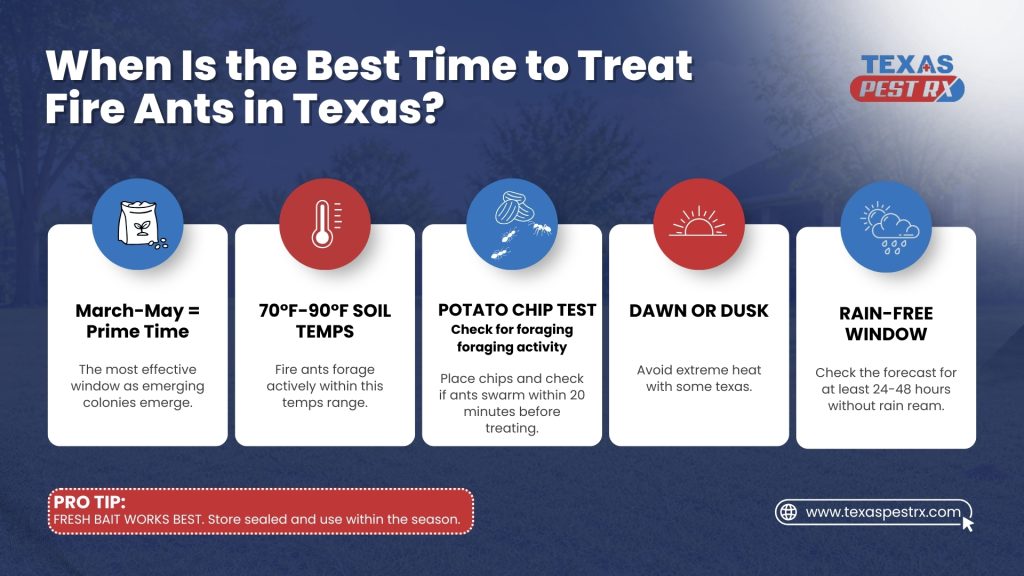
Treat when the soil is warm, and the ants are actively foraging, which in our region usually means mid-spring through early fall. The single best window is a stretch of warm, dry days in spring, often March through May, before colonies grow large and before summer heat drives ants deep.
Timing matters more than people expect, for three reasons.
Foraging activity: Bait only works if workers are out looking for food. A quick test: drop a potato chip or a bit of hot dog near a mound. If ants find it within 10 to 20 minutes, they are foraging, and the bait will work. If nothing shows up, wait for better conditions.
Temperature: Fire ants forage best when the soil surface sits roughly between 70 and 90 degrees. In the heat of a Texas July afternoon, they retreat deep and forage at dawn and dusk instead. Bait in the early evening during peak summer, not at noon. In winter, when the soil dips below about 60 degrees, foraging slows to a crawl, and bait mostly sits there, so save your product for the shoulder seasons.
Moisture: Bait granules are oil-coated and go rancid when wet. Rain also washes them away before ants collect them. Check the forecast and aim for a dry 24 to 48-hour window after you apply. Fresh bait also matters more than people think: an open bag of granules can turn rancid within a few months, and ants will refuse old, stale bait the same way you would refuse spoiled food. Buy what you will use in a season and keep it sealed.
Most yards in our area do well with a spring broadcast and a fall broadcast, with spot treatments as needed between. Two well-timed bait applications usually outperform a dozen panicked spray jobs. After a wet spring, watch for a flush of new mounds about a week behind the rain, which is a good prompt to get the fall round in a little early.
How Do You Keep Fire Ant Mounds From Coming Back?
You keep fire ant mounds from coming back by treating the whole yard on a schedule and removing the conditions that invite new colonies, because in Texas, there is no such thing as a one-and-done. New queens take mating flights and drop into open ground constantly, so reinfestation is normal. The goal is steady pressure, not a single knockout.
A few habits make a real difference for ongoing ant control in your yard:
- Re-bait twice a year. Spring and fall broadcast applications keep colony numbers low before they explode.
- Manage moisture. Fix leaky outdoor faucets, redirect downspouts away from the foundation, and avoid overwatering. Fire ants love consistently damp soil.
- Mind the mulch and wood. Deep mulch beds, wood piles, and stacked timbers give colonies cover. Keep mulch a few inches thick at most and stack firewood off the ground.
- Clean up food sources. Pet food bowls, fallen fruit, and outdoor trash all feed foraging workers. Bring pet food in overnight.
- Watch the property line. Many mounds march in from a neighbor’s yard or an empty lot. If colonies keep appearing along one edge, that edge needs the most attention.
A neighborhood angle is worth knowing, too. Mating flights can carry new queens a quarter mile or more, so if the lots around you are untreated, your yard stays a target no matter how clean you keep it. Some homeowners on the same street split the cost of treating a shared back fence line, which knocks down the reservoir of colonies feeding everyone’s yard. Even a friendly heads-up to a neighbor with an obvious mound problem pays off for both of you.
Stubborn, repeat infestations along fence lines and around slabs are usually a sign that the source sits just off your property, which is the point where a scheduled service starts to pay for itself.
Is Fire Ant Treatment Safe Around Kids and Pets?
Most modern fire ant baits and treatments are low-risk to children and pets when you follow the label, but the safest move is to keep them off treated areas until things settle. The bigger danger in most Texas yards is the ants themselves. Fire ant stings cause painful welts, and a small share of people and animals have serious allergic reactions.
A few safety basics:
- Read the label. The label is the law, and it tells you exactly how long to keep kids and pets out of the area. For most broadcast baits, that is a short window until the granules are picked up or watered in per directions.
- Bait granules look like food. Store products sealed and apply with a spreader so you are not leaving handfuls of granules where a curious toddler or dog can grab them.
- Skip the home remedies. Gasoline, bleach, and other harsh products are far more dangerous to your family, your soil, and your grass than a labeled bait, and they do not work well anyway.
- Treat in the evening. Applying when kids and pets are heading indoors for the night gives the product time to do its job before anyone is back out on the grass.
The sting itself is worth respecting. Fire ants grip the skin with their jaws, then pivot and sting several times in a ring, which is why the welts come in clusters. Within a day, they turn into white pustules that itch for the better part of a week. For a dog, a swarm around the paws or face during play is the most common run-in, and a pet that paws at its mouth or swells up after digging near a mound needs a vet. If anyone in your home has a known sting allergy, an active mound near a play area is a medical concern, not just a nuisance, and it is worth handling quickly and thoroughly.
When Should You Call a Pro?
Call a pro when the mounds keep coming back, no matter what you try, when colonies cluster near doors, play areas, or a foundation, or when someone in the home reacts badly to stings. A trained tech can broadcast the whole yard correctly, hit the right timing, and set up a schedule that keeps pressure on the colonies through the seasons.
There are also cases where doing it yourself just is not worth the trouble. Large properties are hard to bait evenly by hand. Yards backing onto fields or undeveloped land face constant reinfestation. And if you have already spent a summer fighting the same mounds, you are likely facing a source problem that needs a consistent program rather than another bag of product. A pro also carries products and equipment that are not sold at the hardware store, including calibrated spreaders that put down an even rate and stronger spot treatments for problem mounds near a slab or a play set.
It is worth knowing that fire ants rarely travel alone. The same warm, damp conditions that feed them also bring scorpions, centipedes, and millipedes indoors, which is why so many Texas homeowners search for a millipede in the house right around the same time the ants flare up. A yard-wide approach handles more than one problem at once.
Get fire ants handled for good
If you are tired of treating the same mounds over and over, a scheduled, yard-wide plan is the honest path to a fire-ant-free lawn in our part of Texas. At Texas Pest RX, we use the broadcast-plus-spot approach, time it to the season, and keep the pressure on so colonies do not march back in from the property line. Reach out, and we will get your yard on a plan that actually sticks.


