
 260 Reviews


Millipedes turning up inside a slab-on-grade house in South Texas are rarely coming through a defect. They come through the drainage openings that a brick veneer wall is required to have, spaced roughly every two feet around the base of the house, and the single most common mistake homeowners make is trying to seal them. The gap is doing a job. The fix sits outside it, in the strip of ground the wall drains onto.
TL;DR
A brick veneer wall is a drained cavity, not a solid one. Behind the brick there is a required air space of at least an inch, and at the bottom there are weep openings, preferably no more than 24 inches apart, that let water out. Millipedes live in damp organic matter, and that damp organic matter is usually piled against the exact part of the wall the weeps sit in. They enter, then die, because they cannot survive the dry indoor air. University guidance is that indoor pesticide application is rarely necessary for them, and that the work belongs outside.
Why Are They Even Coming Inside?
They are not, in the way that word usually means. Millipedes are not moving in. They are moving through, and then dying.
University of Kentucky Entomology fact sheet on centipedes and millipedes in and around the home puts the biology plainly: millipedes feed on decaying plant material and organic matter; they are associated with damp, moist environments; and, except for house centipedes, most centipedes and millipedes cannot survive in the drier environment inside a home.
The fact sheet goes further. Most millipedes and centipedes will die shortly after entering a structure due to the lack of moisture, and so the application of pesticides inside the home is rarely necessary for millipede or centipede control.
That is the whole diagnostic picture in two sentences. If you are sweeping up dead millipedes, the house is working exactly as the biology predicts, and the population that produced them is outdoors.
The congregations after rain
The other thing people describe is the mass movement, and the honest answer includes an admission.
The guidance notes that millipedes can be seen in large congregations, sometimes on sidewalks, pavers, and foundations, and other times indoors in basements and garages, and that this can coincide with heavy rains. Then it says something most pest control will not: it is unclear what exactly causes such migrations.
If it is happening outside the home, there is likely no issue to be resolved. If it is happening inside, the millipedes will not survive and are usually found dead in piles. Sweep them up, and eliminate the entry point.
Where Is the Entry Point on a Slab House?
Here is the part that is specific to how houses are built here, and it is not a defect list.
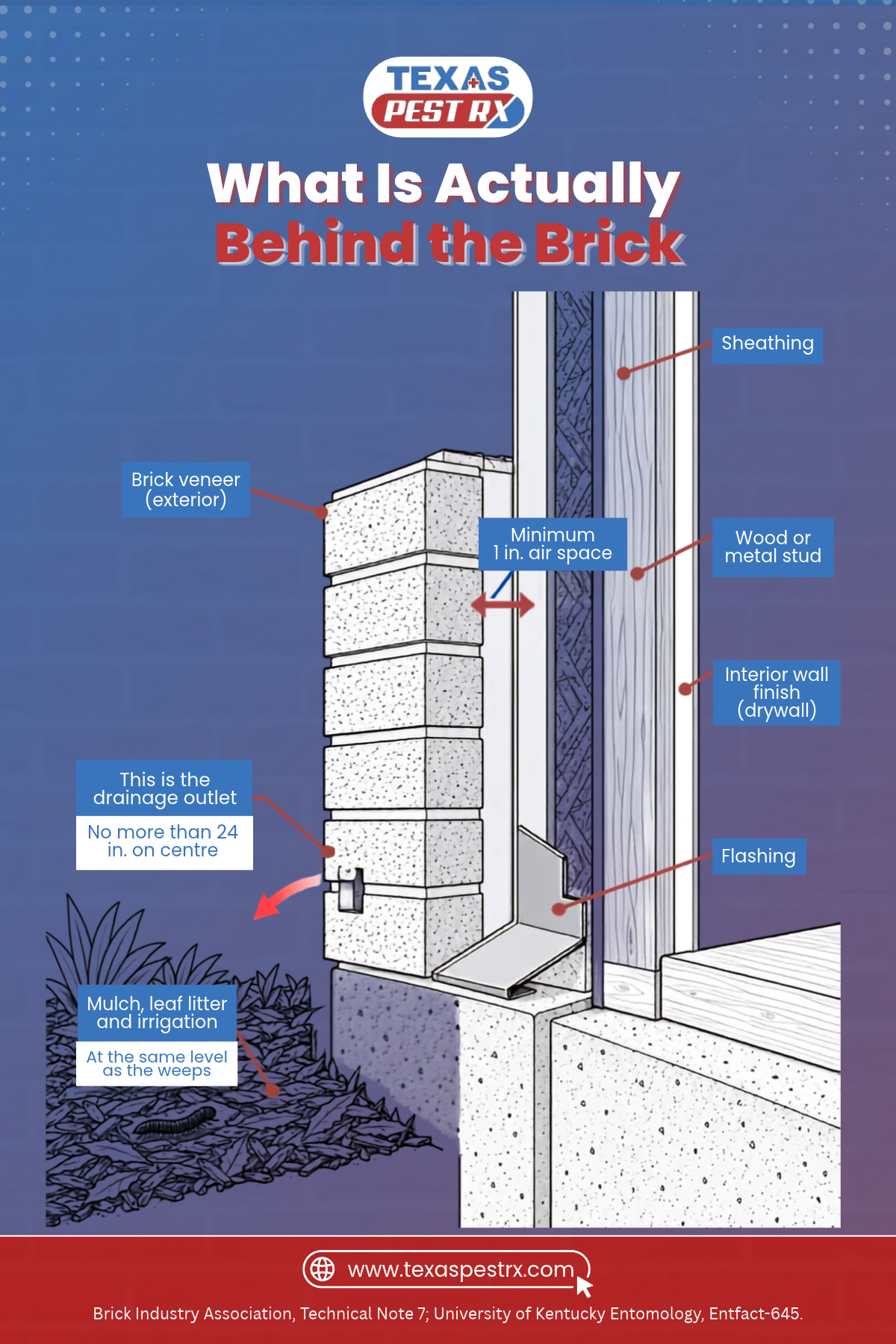
A brick veneer wall is a drainage wall. The brick is not the waterproof layer. Water gets through brick and mortar, runs down the back face, lands on flashing at the bottom, and exits through openings called weeps. For that to work, there has to be a continuous gap behind the brick.
The Brick Industry Association’s technical guidance on water penetration resistance in brick walls sets out the dimensions. A minimum one-inch air space is required behind the brick. Open head joint weeps are recommended at a spacing of no more than 24 inches on centre. Most building codes permit weeps to be no less than three sixteenths of an inch in diameter and spaced up to 33 inches on centre. Where wick weeps are used instead, the recommended spacing tightens to no more than 16 inches.
Read that as a pest problem rather than a masonry one, and it is startling. Around the base of a typical brick house, there is a deliberate opening roughly every two feet, each one leading into a continuous vertical cavity that runs the height of the wall.
Why you must not seal them
Because the weeps are the drainage system, and blocking them puts the water somewhere worse.
The technical guidance is emphatic that the air space must be kept clear so that water can drain, and it recommends against weep tubes specifically because of the increased risk of clogging. A wall whose weeps are sealed holds water in the cavity against the sheathing.
So the instinct is understandable, and the action is wrong. Anyone selling you a millipede treatment that involves caulking the weep holes is proposing to trade an insect that dies on your floor for a moisture problem inside your wall.
Screened weep vents exist and are a legitimate product. Blocking the openings is not the same thing, and the difference matters.
What Actually Fixes It
If the opening cannot be closed, the answer has to be to stop delivering millipedes to it. That is a landscaping job, and it is the one that works.
The Kentucky guidance is direct about the cause: centipedes and millipedes are very sensitive to moisture loss, and high moisture conditions, facilitated by the use of mulch and plants close to homes, are thought to create conducive conditions for millipede habitat. The recommendation is to modify the environment around the home to reduce the populations that accidentally make their way inside.
In practice, on a Texas slab house, that means the first eighteen inches out from the wall.
That strip is usually where a bed sits, where mulch is deepest, where a drip line runs, and where leaf litter collects against the brick. It is also, by construction, exactly where the weeps are. So the habitat is being maintained at the entry point, watered on a timer.
Pull the mulch back off the brick. Keep leaf litter out of that strip. Check that irrigation is not spraying the wall. Make sure water running off the roof leaves rather than pooling along the foundation. None of that is glamorous, and all of it removes the population rather than the individuals.
Do You Need to Worry About Being Bitten?
No, and the detail is worth knowing because a rumour circulates about this one.
There is no bite to worry about. Many millipede species secrete unpleasant-smelling fluids when threatened, and those secretions can cause a dermatological reaction similar to a burn, which is a genuine reason not to handle them barehanded or let a child pick one up.
The cyanide claim is a rumour, and it is half true. Some millipedes can excrete hydrogen cyanide, but as the university guidance states, not in quantities high enough to harm humans.
Centipedes are a different animal on this point. Some can inflict a painful bite. Neither group is broadly dangerous to people, but they are not the same creature, and it is worth being able to tell them apart. Our note on telling centipedes and millipedes apart and what to do about each covers the identification side in more detail.
When Does This Happen in South Texas?
Two patterns, and they have different causes.
The first is rain-driven. After a heavy rain, the ground is saturated, and the congregations appear, which is when most people first notice them on a patio or a garage floor. This is the movement the guidance says nobody has satisfactorily explained.
The second is the opposite. During a dry spell, the moist strip along the foundation may be the only damp habitat left in the yard, particularly where a bed is being irrigated while everything else has gone hard. Then the population concentrates against the wall, and a proportion of it finds the weeps.
Both patterns end in the same place, which is why the fix is the same for both. The strip against the house is either habitat or it is not.
The seasonal read
Autumn tends to produce the most complaints here, because it combines both drivers. Leaf litter starts accumulating against the foundation exactly as the rainfall pattern becomes less predictable, and the beds are still being watered.
The useful work is clearing that strip before the leaves build up rather than after.
How Do You Tell Where They Are Getting In?
Before changing anything, it is worth spending twenty minutes finding out which side of the house is the problem, because it is rarely all of them.
Go out after a rain, when the population is moving, and walk the perimeter. Look at the base of the brick, at the mortar line just above grade. The weep openings are the vertical joints with no mortar in them, and on most houses they are obvious once you know to look for them.
Now look at what is sitting against that course. On one elevation you will usually find a bed with mulch banked up over the brick, or a bin, or a stack of pots, or leaf litter that has been collecting since spring. That is the side producing your millipedes.
Then check indoors. Which rooms are they turning up in, and which exterior wall do those rooms share? A garage on the north side, a utility room, a room at the low corner of the lot. The indoor map points at the outdoor cause more reliably than any amount of inspection from the driveway.
The grade question
One structural thing genuinely is worth checking, and it is not a gap.
Weeps only work if they are above the finished grade. Over years, beds get topped up, mulch is added on mulch, and soil creeps up the wall. Where the ground has risen to the level of the weep course or above it, the drainage openings are now sitting in damp soil rather than in open air.
At that point, two things happen at once. The wall cannot drain properly, and the openings are in continuous contact with the exact habitat millipedes live in. Lowering the grade back below the weeps fixes both, and it is a spade job rather than a contractor job on most houses.
What Does Not Work
Worth listing, because these are the things people try first and they cost money.
Spraying indoors does not work, for the reason the entomology guidance gives: the animals are dying anyway within hours of getting in. A treatment that kills something already dying has no measurable effect on how many arrive tomorrow.
Sealing the weeps does not work either, and it creates a second problem in the wall. Caulking every crack in the foundation misses the point in the same way, since the designed openings are larger than the accidental ones and cannot be closed.
Sweeping alone is maintenance, not a fix. It is the correct response to what is on the floor and it changes nothing about what is at the wall.
What About Treatment?
There is a place for it, and it is not indoors.
Indoor spraying does not solve a problem where the individuals are dying on their own within hours of entry. The population is outside, and it is the outside environment that produces the next wave. A perimeter approach that treats the band of habitat around the structure addresses where the millipedes actually live, and it works alongside the moisture and debris changes rather than instead of them.
Anything applied has to be used according to its label, and the label is the law rather than a suggestion. That applies whether a homeowner buys a product or a licensed technician brings one.
We cover the wider pest control service approach elsewhere, and if you are outside town, our Wilson County coverage explains what a rural property changes about the perimeter.
Fix the Millipede Problem Where the Millipedes Live
The weep openings are staying because the wall needs them. That fixes the shape of the problem: you are not sealing a house; you are managing the eighteen inches of ground it drains onto. Get that strip dry, clear, and free of decaying organic matter, and the millipedes have no reason to be at the wall in the first place.
Texas Pest RX works across Floresville, Wilson County, and the San Antonio area, and if millipedes are turning up indoors after every rain, we can take a look at the perimeter rather than the floor they are dying on.


