
 260 Reviews


Most of the fleas in a South Texas yard are not in the lawn. They are in the shade under the deck, in the dirt where the dog sleeps, and along the side of the house the sun never reaches; the ticks are waiting in the tall grass and brush at the edges. A flea and tick yard treatment works when it goes to those spots and a second visit follows. Sprayed across open, sunny grass, most of it lands where the fleas were never living.
TL;DR
A flea and tick yard treatment in the San Antonio area should be aimed, not broadcast. Texas A&M AgriLife Extension says flea larvae die in hot, sunny lawns and survive in moist, shaded spots near where pets rest, so those shaded spots, pet beds, and dog runs are where outdoor treatment belongs. Fall is when the problem grows here, because the heat that held fleas back through August eases, and September and October are two of the wettest months on San Antonio’s normal calendar. Flea pupae resist insecticide inside their cocoons, which is why fleas seem to come back a week or two after a treatment, and why AgriLife calls for a follow-up 7 to 10 days after the first. Ticks are a separate job: grassy and wooded edges, body checks, and quick removal.
Why Do Fleas Get Worse Here in the Fall?
Fleas get worse in a South Texas fall because the summer that was keeping them in check is over. Texas A&M AgriLife Extension’s guide to controlling fleas states that relative humidity below 50 percent or soil hotter than 95 degrees F kills flea larvae, and that fleas do not survive well outdoors in hot, sunny lawns. August here delivers exactly that. October does not.
The weather record shows the turn plainly. These figures come from the National Weather Service’s monthly and annual normals for San Antonio, the official station for the region.
| Month | Normal high | Days at 90 F or hotter | Normal rainfall |
|---|---|---|---|
| August | 96.0 F | 28.8 | 2.15 in |
| September | 90.1 F | 19.7 | 3.88 in |
| October | 82.2 F | 5.6 | 3.75 in |
| November | 71.7 F | 0.1 | 2.08 in |
Read that table as a flea would. August averages 28.8 days at 90 degrees or above and barely two inches of rain. By October, the 90-degree days are down to 5.6 and the month averages 3.75 inches, second only to September among the months after May. After a fall storm in Floresville or Seguin, the shade under a deck stays damp long after the open lawn has dried, and damp shade is precisely the condition AgriLife names for larvae.
And winter does not reset the yard the way people from further north expect. The same normals put San Antonio at just 14 nights a year at or below freezing, with November averaging 1.3 of them. There is no hard frost in October to end the season for you.
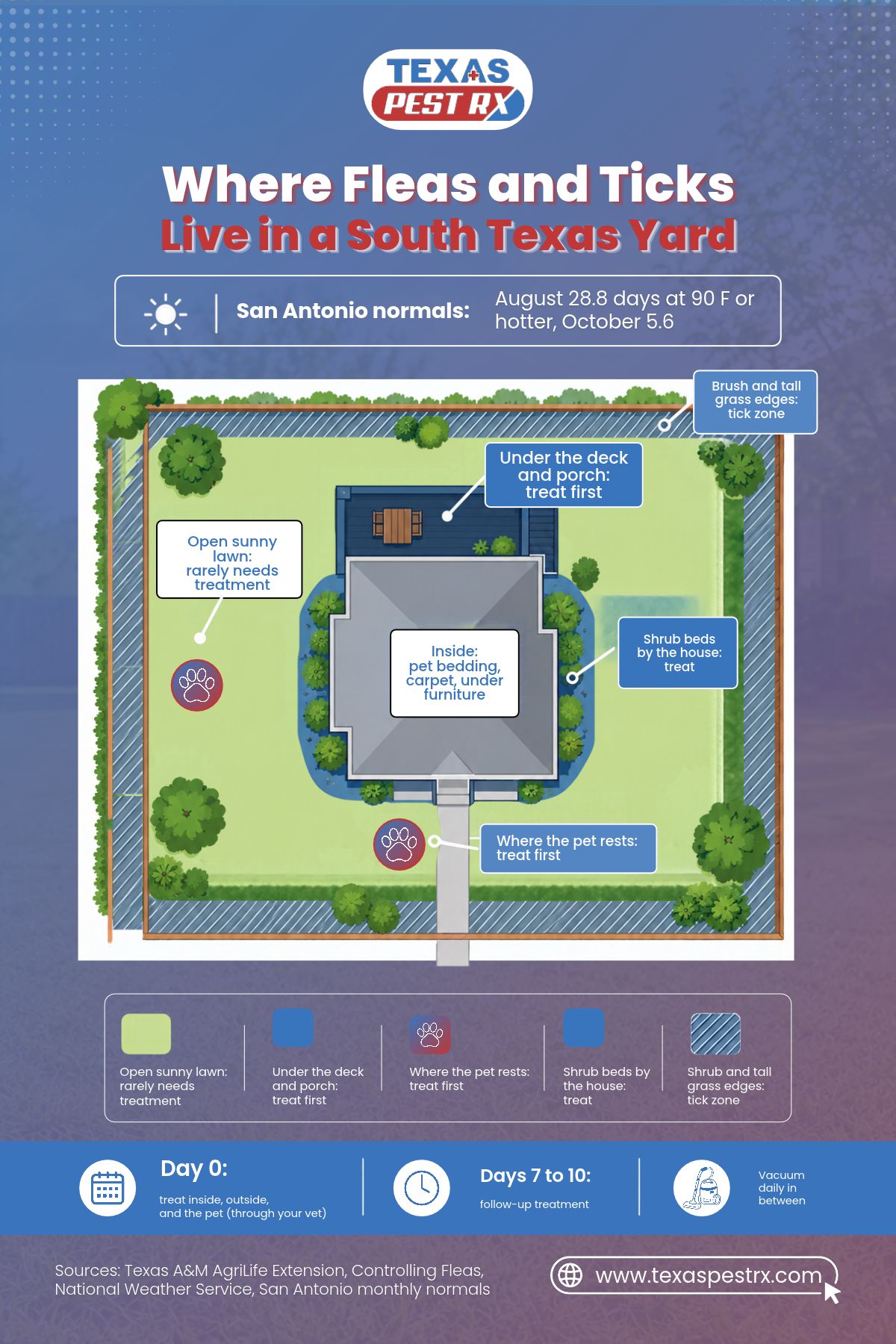
A Walk Across the Yard, Zone by Zone
Stand at the back door and look at your yard in pieces instead of as one lawn. Each piece gets a different answer, and the table below is how we think about it on a property in La Vernia or on the west side of San Antonio alike.
| Zone | What lives there in fall | Does outdoor treatment belong here? |
|---|---|---|
| Open, sunny lawn, mowed | Very little. Per AgriLife, well-maintained sunny lawns are unlikely to harbor many fleas | Rarely |
| Under the deck, porch, or raised shed | Flea larvae and pupae in shaded, damp soil | Yes, first priority |
| Where the dog lies, dog runs, kennels | Eggs and larvae fed by the adult flea droppings that fall there | Yes, first priority |
| Shrub beds against the house | Shade, mulch, and moisture that hold larvae | Yes |
| Fence lines, brush, tall grass edges | Ticks waiting on vegetation; wildlife traffic carrying fleas | Yes, for ticks |
| Inside: pet bedding, carpet, under furniture | Larvae and cocoons | Yes, at the same time as outside |
The shade under structures
If you only look in one place, look here. The ground under a deck or a pier-and-beam porch never sees direct sun, holds moisture after rain, and is often exactly where a dog or a stray cat goes to get out of the heat. AgriLife lists the ground under decks and shrubbery by name as a flea breeding site.
The pet’s own map
Watch where your animals actually spend the day. A dog that sleeps on the north side of the house, or digs a cool hollow under the live oak, has drawn you a flea map. Larvae feed on adult flea droppings, the fine reddish-black dust you sometimes see in pet bedding, so the heaviest larval populations sit where the pet rests longest.
The edges
Ticks behave differently, and the grassy and wooded edges are theirs. On a larger lot around Stockdale or Poth, that edge can run the whole length of a fence line.
What Is a Flea and Tick Yard Treatment Supposed to Cover?
A flea and tick yard treatment is supposed to cover the shaded breeding spots, the pet resting areas, and the brushy edges, and it is supposed to happen alongside treatment of the pet and the inside of the house. AgriLife’s instruction is direct: outdoors, treat only flea breeding sites, such as bedding areas, the ground under decks and shrubbery, and wherever pets spend a lot of time.
That runs against what most product labels and retail guides show you, which is a person walking the whole lawn with a hose-end sprayer. The open lawn is the part of the yard least likely to need it.
Here is how the pieces fit together:
- The pet. On-animal products are a conversation for your veterinarian, and the extension notes that several of the most effective ones are only sold through vets. Products made for adult dogs should never go on cats or puppies unless the label says so.
- The inside: pet bedding, carpets, under furniture, and along walls, treated at the same time as the pet.
- The outside, meaning the zones in the table above, is aimed at shade and resting spots.
- A follow-up visit, covered in the next section and skipped more often than any other step.
Our flea and tick control covers the indoor and outdoor parts of that list, carpets and furniture inside, and yards and outdoor living areas outside, with prevention steps and an optional ongoing plan after that. The pet itself stays with your vet.
If any of the four is left out, the other three are working against a steady supply of new fleas.
The Two Weeks After a Treatment
Almost every flea call that goes badly goes badly here. The treatment happens, the fleas drop off, and then ten days later someone is standing in the kitchen with bites around their ankles again, sure the product failed.
It usually did not fail. It never reached the pupae.
According to AgriLife, flea larvae spin a cocoon; the pupa inside turns into an adult in a week or two, and that adult can sit in the cocoon for up to five months. It comes out within seconds when something passes by. Insecticide struggles to get through that cocoon, so the adults that were already developing keep emerging after the spray has done its work on everything else.
What the next two weeks should look like
| When | What happens | What you do |
|---|---|---|
| Day 0 | Treatment inside and out; pet treated through your vet | Vacuum first; stay off wet carpet until it dries |
| Days 1 to 6 | Some fleas still appear as cocoons open | Keep vacuuming daily; this is expected |
| Days 7 to 10 | AgriLife’s window for the follow-up treatment | Second treatment of the same spots |
| After that | Numbers fall off as the pupae run out | Keep the pet on its vet product |
Vacuuming earns its place in that table. By the extension’s count, it removes up to 30 percent of larvae and up to 60 percent of flea eggs from carpet, and the vibration coaxes waiting adults out of their cocoons where the treatment can reach them. Empty the bag or canister outside, since fleas can keep developing in there.
A long-empty house can do the same thing on a bigger scale. The same guide describes vacant homes that come alive with fleas when new people move in, because the footsteps wake up months of stored adults at once.
What not to do in those two weeks
Resist the urge to hit the yard again yourself every time you see a flea. A new flea on day four is a cocoon opening on schedule, and a second product layered over the first rarely changes that. It can mean doubling up on active ingredients around the pets, which is the risk the extension has in mind when it says to read and follow every label carefully and to remember that a product safe for dogs may not be safe for cats, puppies, or kittens.
Keep the vacuum going, keep the pet on whatever your vet chose, and let the follow-up do its job. If fleas are still climbing after the second treatment, that is when the question changes to where they are coming from, which is usually the subject of the next section.
Fleas With No Pet in the House
Sometimes there is no dog, no cat, and still fleas. That points somewhere specific.
The usual sources, in the extension’s list, are wildlife nesting in or on the building: bats, roof rats, squirrels, raccoons, and feral cats. If you are getting bitten indoors with no pet at home, the question becomes what is living in the attic, the crawlspace, or under the porch. The roof rats that move into South Texas attics are a common answer around here, and fleas that have fed on rodents are a different concern from cat fleas. AgriLife notes that rodent fleas can carry diseases such as murine typhus, while cat fleas do not carry plague.
So treating the fleas alone is only half of this job. Until the animal is out and the opening it used is closed, new fleas keep arriving.
Ticks Follow Different Rules
Ticks do not breed in your carpet, and they are not a pet-bedding problem. They wait on vegetation and climb onto whatever brushes past, which is why the tick part of the yard is the tall grass, brush, and wooded edges rather than the shade under the deck.
The Texas Department of State Health Services says ticks are most active in the warmer months of spring and summer. In a region where the normal October high is still 82 degrees, warm weather lasts a long time. On the state’s ehrlichiosis page, the department puts the usual exposure season at April to October and says evidence points to the Lone Star tick as the carrier. Elsewhere, the department describes the Lone Star tick as very common in Texas.
A few facts from the same department are worth keeping on the fridge:
- If you remove an attached tick within 36 hours, the department says the risk of infection is minimal.
- Pull with tweezers close to the skin, with steady pressure. No petroleum jelly, no match, no nail polish.
- After time outside, check behind the knees, under the arms, around the ears, along the hairline, and anywhere clothing presses on skin.
- Texas is a low-incidence state for Lyme disease. Most Lyme cases reported here were picked up in another state.
- DSHS offers free testing of ticks that were attached to a Texas resident, meant for surveillance rather than diagnosis. Symptoms after a bite are a reason to see a doctor, not to wait for results.
That list is about people. For the yard, the practical move is keeping the grass at the edges short, cutting back brush where the kids and dogs actually walk, and treating those edges when numbers are high. More of the tick searches that reach us come from San Marcos than from anywhere else we serve, with New Braunfels close behind, and any yard there that backs onto brush or a wooded creek bank has a long tick edge to manage.
What to Answer Before Anyone Treats Your Yard
A good flea and tick visit starts with questions, not a sprayer. Whoever you hire, us included, these are worth having answers to first:
- Which pets live here, indoors or out, and are they on a vet flea product right now?
- Where do they sleep, inside and outside?
- Is there a deck, porch, shed, or crawlspace they can get under?
- Any sign of wildlife: droppings in the attic, digging under the slab edge, a raccoon on the fence at night?
- Are the bites mostly on ankles and lower legs? AgriLife says that is the typical cat flea pattern.
- Is anyone finding ticks attached, and where have they been walking?
- Are there kids or pets who will need to stay off treated areas until they dry?
The last one matters more than it looks. Texas A&M’s advice is to keep people and pets off treated carpet until the spray has dried, usually at least two hours, and outdoor areas the same way. Plan the visit around that, especially in a busy house in Pleasanton or Cibolo with dogs going in and out all afternoon.
Get the Yard Checked While the Weather Still Favors the Fleas
Late September is the right moment for this, not the wrong one. The heat that held fleas back is going, the fall rains are here, and the first freeze in San Antonio is weeks away at best. If your dog is scratching more than it did in July, or you have been picking ticks off after walking the back fence, the conditions are only moving in their favor for now.
We serve Floresville and the rest of Wilson County, along with San Antonio, Seguin, New Braunfels, San Marcos, and the surrounding towns. Texas Pest RX can look at the shade, the pet areas, and the edges with you and treat what needs it. When you are ready, book a yard and house visit and tell us which pets live there so we can plan around them.


