
 260 Reviews


A scorpion found in a house between Floresville and San Antonio is most likely a striped bark scorpion. Texas A&M AgriLife counts 18 scorpion species in Texas, and this is the only one found statewide. It walked in through a gap, usually looking for water or a milder temperature, so the place to start is the outside wall and not the room where you saw it.
TL;DR
Scorpions in Texas homes are usually striped bark scorpions: yellowish-tan, with two dark stripes down the back, and up to 2.5 inches long. Texas A&M AgriLife Extension entomologists in Bexar and Travis counties tie indoor sightings to weather. Hot, dry summers send scorpions looking for water and cooler air, and fall rain and cool fronts push them toward shelter again. They get in under doors, through weep holes, around pipes, and off branches that touch the roof. AgriLife calls exclusion the best defense: seal the openings, move firewood and debris off the wall, then treat the foundation and entry points if scorpions keep showing up. For a sting, MedlinePlus says most stings from North American scorpions do not need treatment, and the national Poison Help line, 1-800-222-1222, answers day and night.
Which Scorpion Is It?
It is most likely the striped bark scorpion. When calls about scorpions picked up around San Antonio in the summer of 2018, Texas A&M AgriLife Today reported that Texas has 18 species of scorpions, that only the striped bark scorpion occurs throughout the state, and that it is the most common species in Central Texas. That December, one of the same entomologists called it the most common scorpion in South Central Texas as well.
So the odds are settled before you look closely. Looking closely still helps, because it tells you whether the animal in the jar matches the description or is something worth photographing for a second opinion.
What the striped bark scorpion looks like
Everything in this table comes from AgriLife’s description, given by Travis County extension entomologist Wizzie Brown.
| Feature | What to look for |
|---|---|
| Color | Yellowish-tan |
| Markings | Two dark stripes running along the back |
| Size | Up to two and a half inches long |
| Body | Flat, which lets it slide into small cracks and under bark, stones or wood |
| Front | Two pincers, used to hold prey while it eats |
| Tail | Long, with the stinger on the tip |
| Habits | Hides by day, active at night |
Brown added a detail that explains a lot of indoor encounters. Scorpions do not see well. They find their way by touch, which fits where AgriLife says to look for them indoors: corners, cracks, and crevices.
Central Texas has a second scorpion people ask about. On AgriLife’s Urban IPM blog, Brown describes the Texas cave scorpion as darker, with thicker pincers, living in caves, grottos, and other limestone features in the rockier parts of Central Texas. That is Hill Country terrain. New Braunfels and San Marcos sit on its edge, and Wilson County does not, so a dark, heavy-clawed scorpion is a far less likely find in Stockdale or La Vernia than a pale striped one.
The blacklight check
Scorpions glow under ultraviolet light. AgriLife’s 2023 advisory says a UV light at night can help you find them because they show up blue-green, and that sticky traps placed in those spots can catch them.
Two cautions from Brown’s writing on the subject. Dead scorpions glow as well as live ones, so a glowing shape that never moves may be last month’s. And the glow builds with each molt, which means the smallest young are the hardest to see.
Wear closed shoes for this. Walk the base of the outside wall first, then the garage, then the bathrooms.
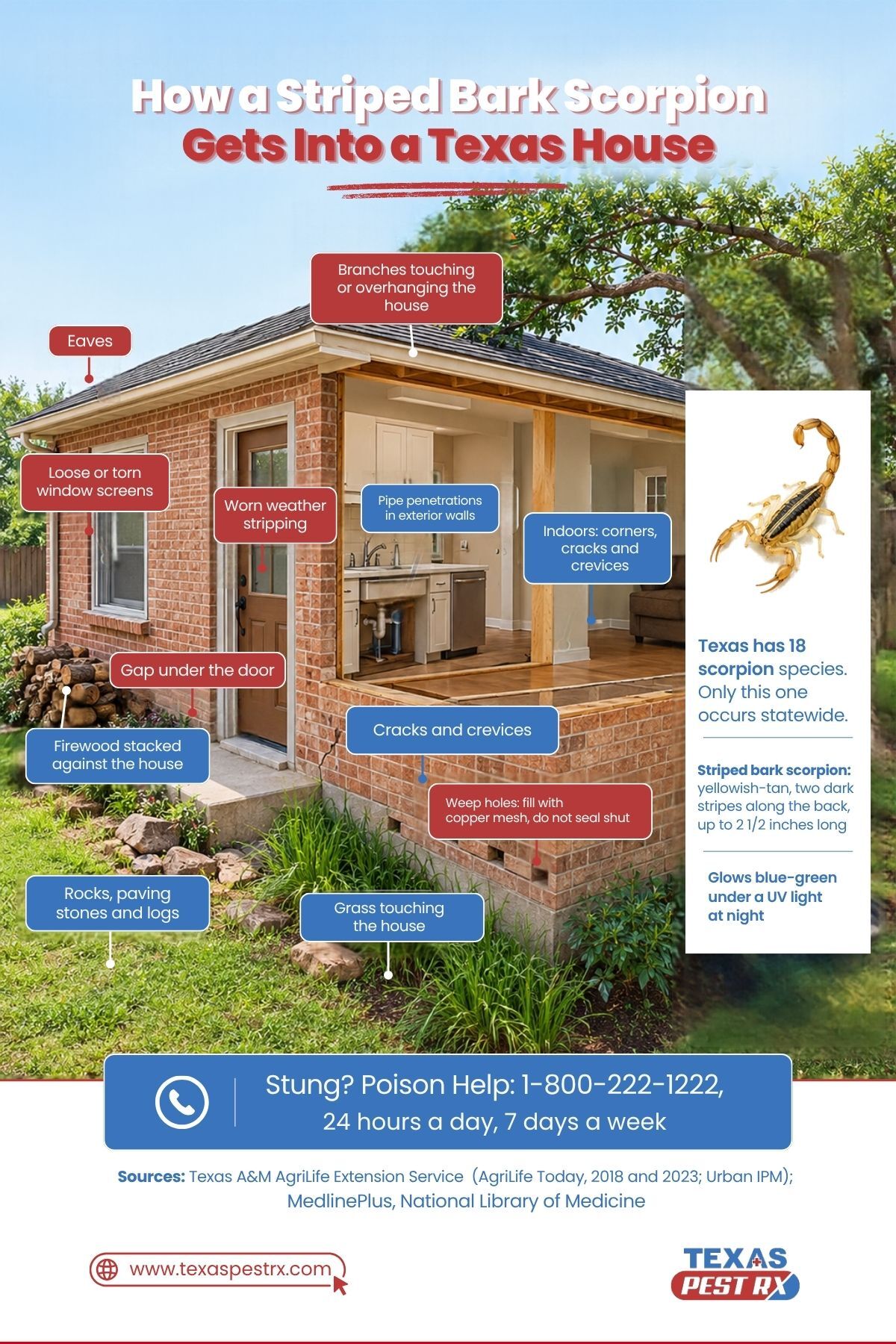
Why Do Scorpions Come Inside a Texas House?
Scorpions come inside for water and for a temperature they can tolerate, and in this part of Texas the weather pushes them more than once a year. Bexar County extension entomologist Molly Keck put it plainly in 2018: scorpions do not seem to like either very cold or very hot temperatures, and in hot, dry weather they may go looking for water or a more hospitable place. Your house offers both.
The next push comes right about now. In October 2017, Keck and Brown told South Central Texas residents that recent rains and cooler weather would drive outdoor pests indoors, and they named spiders, scorpions and millipedes together.
| Trigger | When it hits here | What the extension entomologists said |
|---|---|---|
| Heat and drought | Summer | Scorpions look for water and cooler temperatures, and squeeze in where they feel a temperature difference under a door or at a small crack |
| Rain and cool fronts | Fall | Recent rains and cooler weather drive spiders, scorpions and millipedes indoors |
| Cold | Winter | Scorpions are among the pests likely to try to enter homes during cold weather |
That first row is the one to read twice. In AgriLife’s September 2023 report on pests moving indoors, Keck described scorpions feeling the temperature difference below a door or by another small crack and squeezing their way inside. An air-conditioned house in August leaks cool air at every gap. To a scorpion working along the slab by touch, that leak is a signpost.
There is a local reason to take the pattern seriously. The 2018 advisory opened with Keck saying her office had been getting a lot of calls about scorpions from residents of San Antonio and from surrounding counties. Wilson County borders Bexar County, so Floresville sits in one of those surrounding counties.
Where You Found It Says How It Got In
The extension sources name the openings. Matching each one to a room is our own reading of them, offered as a place to start looking and not as a diagnosis.
| Where it turned up | Likely route | Check this first |
|---|---|---|
| Bathroom or under a sink | Water. Pipe penetrations in the exterior wall | The gap around supply and drain lines where they pass through the wall |
| Just inside an exterior door | The gap under the door | Weather-stripping and the threshold, with a flashlight from outside at night |
| Along a brick or stone wall, low down | Weep holes | Open weep holes at the bottom course of the veneer |
| Near the fireplace or the wood basket | Carried in with firewood | Where the firewood is stacked outdoors |
| Upstairs, or far from any exterior door | The roof and attic | Branches touching or overhanging the house, and the eaves |
| Garage | Cover close to a large door | Stored boxes on the floor and anything stacked against the house wall |
Bathrooms and kitchens
AgriLife’s 2023 piece describes the scene most people report: the bathroom light goes on at night and a scorpion scurries behind the toilet. Water is the draw. The 2018 exclusion list names areas of pipe penetration in exterior walls as a spot to seal, and those penetrations sit behind vanities and under sinks, where nobody looks.
The roof route
This one surprises people. Brown wrote that trees touching or overhanging a house let scorpions and other pests use them as a bridge onto the roof and from there into the attic. AgriLife lists bark among the things this scorpion hides under, so a tree limb is familiar ground. If yours appeared on a second floor or in a hallway far from any door, look up before you look down.
Firewood and the garage
Firewood stacked beside the back door is, in Brown’s words, a perfect hiding place for scorpions, and they can be carried in with the wood.
The Texas Poison Center Network makes a related point: critters take refuge in garages, and footwear or clothing stored outdoors should be checked before you put it on. A garage door rarely seals as tightly as a front door, so the door from the garage into the house deserves the same weather-stripping check as any other exterior door.
Does One Scorpion Mean There Are More?
Nobody can answer that from a single sighting, and none of the extension material we read puts a number on it. One scorpion does prove two things: there is an opening big enough for a flat-bodied animal, and there is shelter for scorpions close to the house.
A few facts help you judge the rest. Scorpions hide all day, so a quiet week proves little.
They also live a long time. AgriLife gives a usual lifespan of three to five years, with a record of 25 years in captivity, and remarks that it is not as if you want to wait one out. Females bear live young and carry them on their backs until the first molt, as Brown describes on the Urban IPM blog.
A blacklight walk on two or three warm nights will tell you more than guessing. So will a handful of sticky traps along the walls where you saw the first one. To our eye, nothing on the traps and nothing glowing along the foundation is a reasonable sign that you had a wanderer. Several, or small ones, suggest the yard is feeding the house and the outside work below is not optional.
Closing the House Up, Outside First
Both entomologists said the best defense against scorpions is exclusion, and in 2017 they called fall a good time to do it. October weather in La Vernia or on the south side of San Antonio is about as pleasant as outdoor chores get, which helps.
This is their list, in the order we would walk it:
- Move firewood and debris away from the house. Rock piles, bricks, and stacked lumber count.
- Prune any tree or shrub that touches the wall or hangs over the roof.
- Keep grass near the house closely mowed.
- Replace worn weather-stripping around doors and windows.
- Check that window screens are in good repair and fit tightly in the frame.
- Seal cracks, crevices, and pipe penetrations in exterior walls. Brown recommends a sealant that expands and contracts with Texas weather.
- Fill smaller holes with steel wool or copper mesh, and use caulk or expanding foam on larger gaps where pipes or wires come through.
- Put steel wool, copper mesh, or screen wire in the weep holes of brick, stone, or stucco walls.
Number eight needs care. Weep holes are there on purpose, and Brown is specific that you do not seal them completely because they help air move through the wall void.
Mesh keeps a scorpion out and lets the wall breathe. Caulk does the first and ruins the second. We covered that wall detail in our piece on how millipedes get past a Texas slab, and the same joint matters here.
One more item, from Brown: firewood kept inside the house will bring the occasional passenger with it. Carry in what you plan to burn that night.
Spiders use the same openings, which is why the 2017 advisory lists them in the same breath. If you are seeing both, our spider control work starts with the same kind of property inspection.
Where Treatment Fits and Where It Does Not
Pesticide is the second step in AgriLife’s advice, not the first, and the placement is narrow. If scorpions are found, the entomologists suggest treating around the foundation and up to one foot above ground level on the exterior walls, plus around doors, windows, eaves, and other likely points of entry. Indoors, treatment is directed at entry points and at the corners, cracks and crevices where scorpions hide. Label directions govern the dose, the mixing and the method.
Notice what is missing from that description. Nothing in it calls for spraying open floors, furniture, or the middle of the lawn.
Brown’s own order of operations on the Urban IPM blog is worth repeating: do the exclusion work, and if you are still having problems, try a residual spray around the foundation. A house with an open gap under the back door and a woodpile against the wall will keep receiving scorpions no matter what is sprayed.
If you have sealed what you can reach and they keep appearing, that is when to hand it over. Our scorpion control visit begins with an inspection of the house and yard, treats baseboards, wall voids, and the outdoor perimeter, and includes exclusion work on the entry points, with an ongoing plan available afterward. We work in Wilson, Bexar, Guadalupe, Karnes, and Atascosa counties.
What a Sting Usually Involves
This section reports what medical and extension sources say. It is not treatment advice from us, and MedlinePlus, from the National Library of Medicine, says of its own scorpion page that it is for information only and should not be used to treat or manage a sting.
What those sources state:
- In mild cases, the only symptom may be a mild tingling or burning at the site of the sting (MedlinePlus).
- Most stings from North American scorpions do not need treatment (MedlinePlus).
- Children 6 years and younger are more likely to have harmful effects from venomous types of scorpions (MedlinePlus).
- A striped bark scorpion sting typically causes only moderate reactions in most people, though severity depends on the individual scorpion and the person (AgriLife, 2018).
- Only the Arizona bark scorpion has a fatal sting, and it is not found in Texas (AgriLife, 2023).
- A person who has been stung should be watched closely for several hours. Difficulty breathing or hives mean immediate medical attention (AgriLife, 2018).
MedlinePlus directs anyone who is stung, or who is with someone who is, to call the local emergency number or the national Poison Help hotline at 1-800-222-1222. The line is free and confidential; it runs 24 hours a day and 7 days a week, and the call does not need to be an emergency.
Have the person’s age, weight, and condition ready, along with the time of the sting and where on the body it landed. A photo of the scorpion helps, but only if you can take one safely.
In Texas, that number reaches the Texas Poison Center Network, which is made up of six regional poison centers. One of them is the South Texas Poison Center at the University of Texas Health Science Center at San Antonio.
Walk the Outside Wall for Scorpion Gaps Before the Next Cool Front
Pick an evening this week and walk the outside of the house with a flashlight and a blacklight if you have one. Look at the bottom of every exterior door, the weep holes, the pipes entering the wall, the woodpile, and any branch within reach of the roof. Much of what you find is mesh, sealant, and pruning saw work.
If the count on the sticky traps keeps climbing, or you would rather not be the one checking the eaves, Texas Pest RX can take it from there. We are based in Floresville and work across Wilson County and into San Antonio. You can request a scorpion inspection and tell us which rooms they have turned up in, because that is the first thing we will want to know.


